

MARKET OVERVIEW
Grains & Oilseeds held firm this week: the July 10 WASDE report lifted the 2026/27 U.S. season-average soybean price to $11.40/bu on record crush demand and sustained Chinese import buying, with new-crop futures trading near two-month highs above $12/bu even as USDA still projects a record U.S. harvest.
Cocoa was again the week’s most volatile mover, swinging between multi-month lows and sharp rebounds as rising ICE inventories and soft European demand — Q2 grindings fell 4.6% y/y to a record-low 316,366 MT — were weighed against a now 96% WMO-flagged probability of a Super El Niño and a downgraded 2026/27 Côte d’Ivoire crop of just 1.7–1.8 million MT.
Raw Cashew Nut entered the 2026/27 marketing year on a tighter footing: Nigeria’s farmgate season has wound down with the crop estimated at 350,000–400,000 MT, while sustained procurement from Vietnamese and Indian processors is absorbing the oversupply that weighed on prices through 2025.
Sesame Seed exports stayed concentrated in West Africa, with Nigeria, Sudan and India together commanding 45% of global export value; Nigerian farmgate transaction prices traded in a $0.92–$1.17/kg range through June, with China continuing to anchor global import demand.
Dried Hibiscus held stable on steady export demand and favourable planting conditions across Kano, Katsina and Jigawa, with global buyer interest continuing to broaden on the back of the natural-ingredient and functional-beverage trend.
KEY CATALYSTS THIS WEEK
- Super El Niño risk now at 96% probability — the WMO’s highest-ever reading at this stage, historically tied to 30–50% West African output declines.
- Côte d’Ivoire crop surveys point to 1.7–1.8M MT, down 18% y/y, even as season-to-date port arrivals of 1.91M MT (+18.4% y/y) offer near-term comfort.
- West African origination ties all four Agro commodities together — procurement financing needs are rising in step with tightening supply across cocoa, cashew, sesame and hibiscus.
Regional Supply Concentration Risk
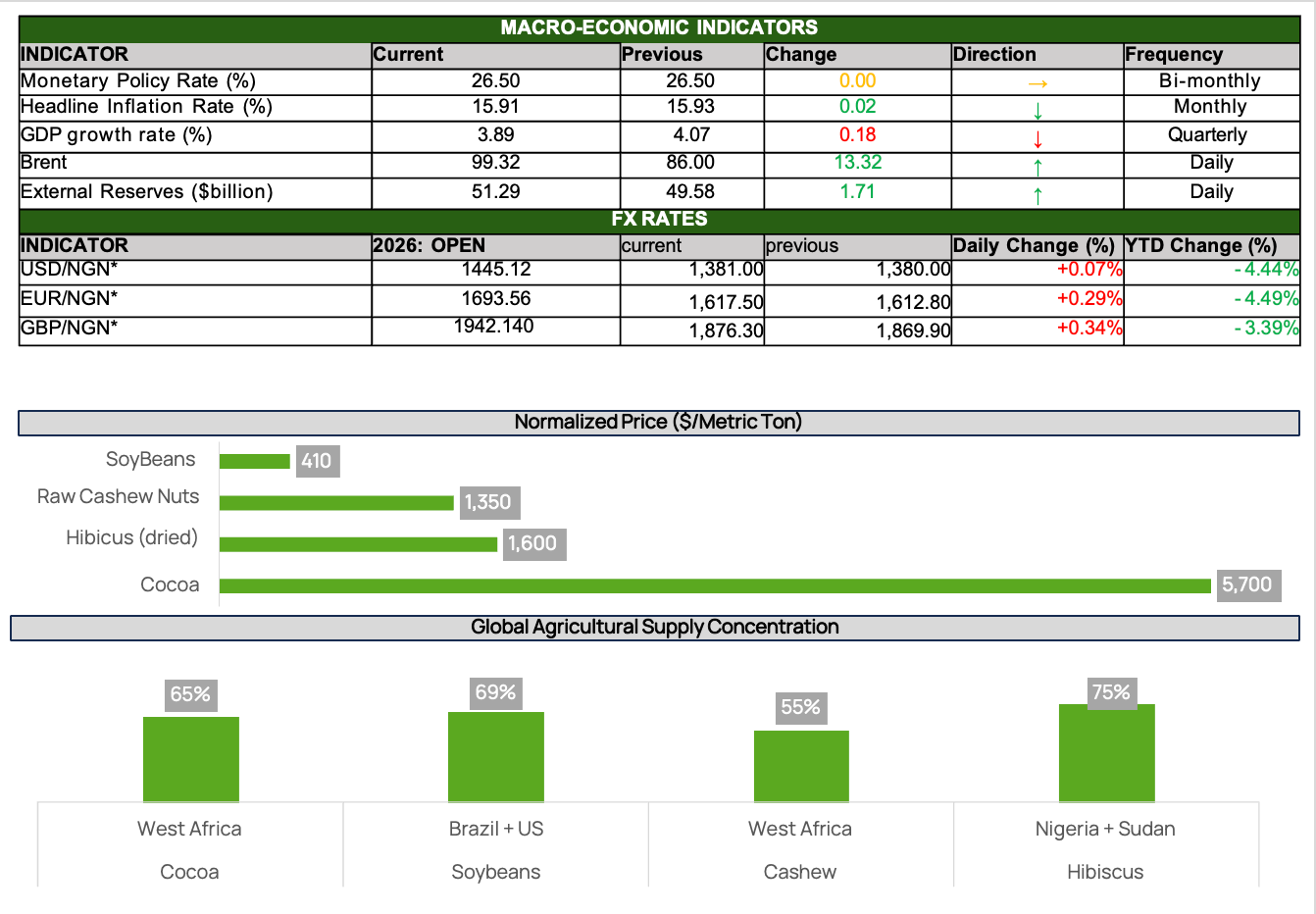
Global agricultural commodity markets remain highly concentrated, making prices particularly sensitive to disruptions in a few key producing regions. West Africa supplies approximately 65% of global cocoa and 55% of raw cashew, while Nigeria and Sudan account for about 75% of global hibiscus exports. In soybeans, Brazil and the United States contribute nearly 69% of global production.
The impact of this concentration was evident in 2026, when heavy rains across Côte d’Ivoire and Ghana disrupted cocoa production and lifted prices to around US$5,700/MT, demonstrating how localized supply shocks can rapidly influence global markets.
From a structured finance perspective, concentration risk extends beyond production—it directly affects collateral values, trade flows, financing costs, and borrower cash flows.
Commodity traders, exporters, processors, and lenders should therefore strengthen resilience by diversifying sourcing and export markets, maintaining strategic inventory buffers, and implementing commodity and FX hedging strategies. These measures help preserve margins, reduce earnings volatility, and improve bankability.
KEY TAKEAWAY
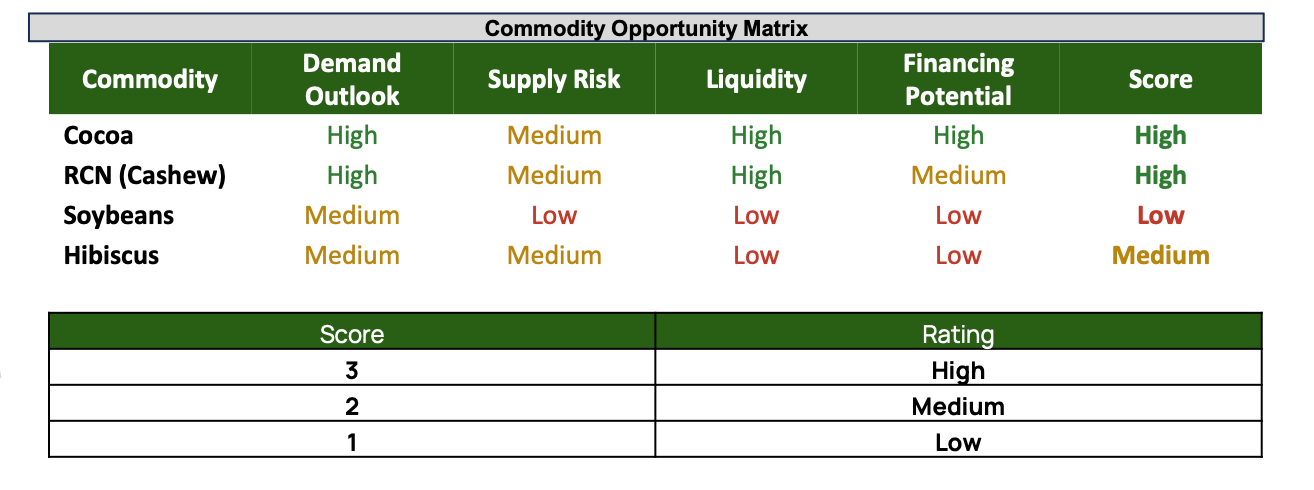
Cocoa and RCN screen as Nigeria’s highest-conviction opportunities — both rate are on high on demand outlook, liquidity and financing potential, with only moderate supply-risk exposure from West African concentration.
Soybeans and hibiscus lag: soybeans face tight liquidity despite steady demand, while hibiscus is constrained on both supply risk and financing.
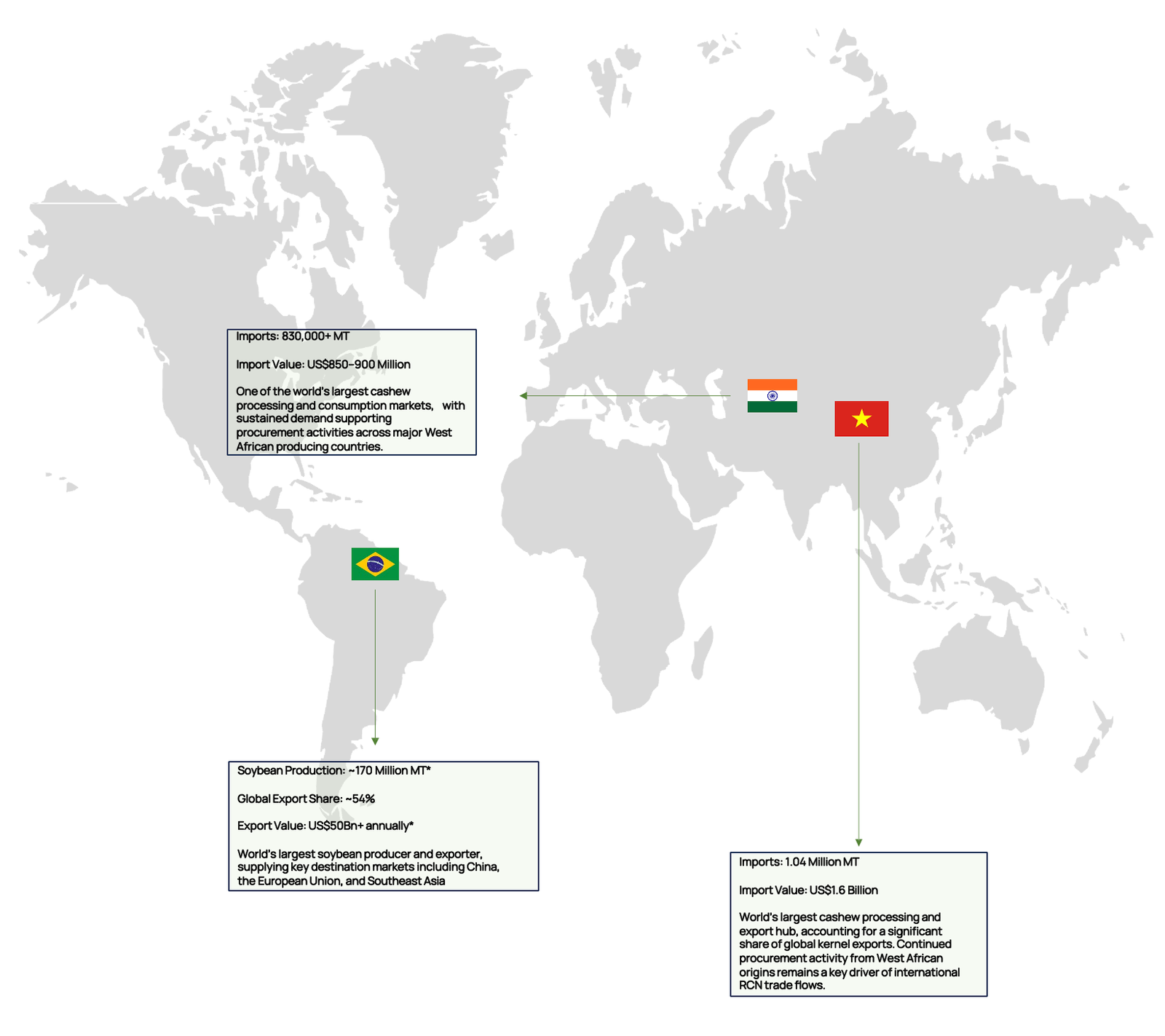
India and Vietnam together absorb ~1.9 million MT of cashew imports worth over US$2.4 billion annually — a deep, liquid offtake market — while Brazil’s ~54% share of global soybean exports leaves little room for Nigeria to compete on that crop.
With cocoa futures at a 24-week high and cashew processing capacity constrained by financing, the window to lock in favorable offtake and hedging terms is narrowing.
BOTTOM LINE
Prioritize cocoa and cashew financing and hedging structures this quarter. Deep Asian offtake demand (~$2.4bn from India and Vietnam alone) and strong liquidity scores make both crops Nigeria’s clearest near-term value-creation opportunities.
Size soybean and hibiscus exposure more conservatively — both score lower on financing access, and Brazil’s scale advantage caps Nigeria’s competitiveness in soybeans specifically.
Watch the cocoa/cashew policy debate closely — processing-capacity constraints mean export restrictions could disrupt farmgate prices before local capacity catches up.
COMMODITY SPOTLIGHT: COCOA & CASHEW PROCESSING POLICY.
Nigeria’s cocoa and cashew value chains are entering a pivotal policy window. President Tinubu used the Cocoa Value Addition Summit 2026 to declare an end to raw bean exports, while the Ministry of Industry unveiled a National Cashew Roadmap on July 15 — but implementation, not ambition, is now the swing factor for prices and farmer incomes:
- Cocoa messaging softened fast — President Tinubu’s summit remarks were widely read as an export ban; within three days, Agriculture Minister Kyari clarified the goal is value addition, not prohibition, and raw exports will continue.
- Cashew ban proposal is contested — CAPPAN (processors) is pushing an outright raw cashew export ban, but NCAN (farmers/exporters) warns it would endanger roughly 5 million livelihoods to create just ~35,000 processing jobs.
- Processing capacity is the real constraint — Nigeria’s ~15 active cashew plants can handle only ~55,750 MT of the 300,000–350,000 MT produced annually — under 20% — while cocoa’s $890M in processed exports still trails $1.63bn of raw bean shipments.
Policy Fundamentals: Nigeria’s push mirrors its 2025 raw shea nut export ban (extended into 2026), which cut off buyers overnight and depressed farmgate prices before local capacity could absorb the shortfall. The Cashew Roadmap and cocoa value-addition drive both align with the 2026 Nigeria Industrial Policy, but neither has yet published binding export restrictions — for now, both remain incentive-led.
Industry Reaction: Farmer and exporter groups (NCAN) are the loudest opponents of a cashew ban, arguing financing costs of 25–35% and a 3–4-month harvest window against 9 months of required storage make processing uneconomic without state support. Processors (CAPPAN) counter that foreign buyers are starving local factories of raw material at the farm gate.
Investment & Trade Impact: New capacity is coming online regardless of the policy outcome — a cocoa processing plant in Sagamu, Ogun State, and Sunbeth Global Concepts’ 70,000 MT cocoa and 80,000 MT cashew facilities (commissioning March 2027) would roughly double Nigeria’s processed cocoa capacity. Until then, Nigeria’s raw cocoa and cashew export base remains exposed to any abrupt policy reversal, as the shea precedent showed.


H2 2026 Policy Scenarios:
BEAR — Government imposes an abrupt raw cashew export ban, mirroring the 2025 shea precedent, before processing capacity or financing gaps are addressed; farmgate prices collapse and smallholder incomes suffer (25% probability).
BASE — FG holds the “value addition, not ban” line; the Cashew Roadmap and cocoa investment incentives proceed alongside continued raw exports, with capacity building gradually through 2027 (50% probability).
BULL — New financing facilities and the Sagamu/Sunbeth plants come online on schedule, roughly doubling processed cocoa and cashew capacity by 2027 and lifting Nigeria’s local value-addition share meaningfully (25% probability).
Key Takeaway: Policy direction clearly favors local processing, but Nigeria’s ~55,750 MT of active cashew capacity against 300,000+ MT of annual output means execution — not intent — will determine whether this becomes a genuine value-addition win or a repeat of the disruptive 2025 shea ban.