

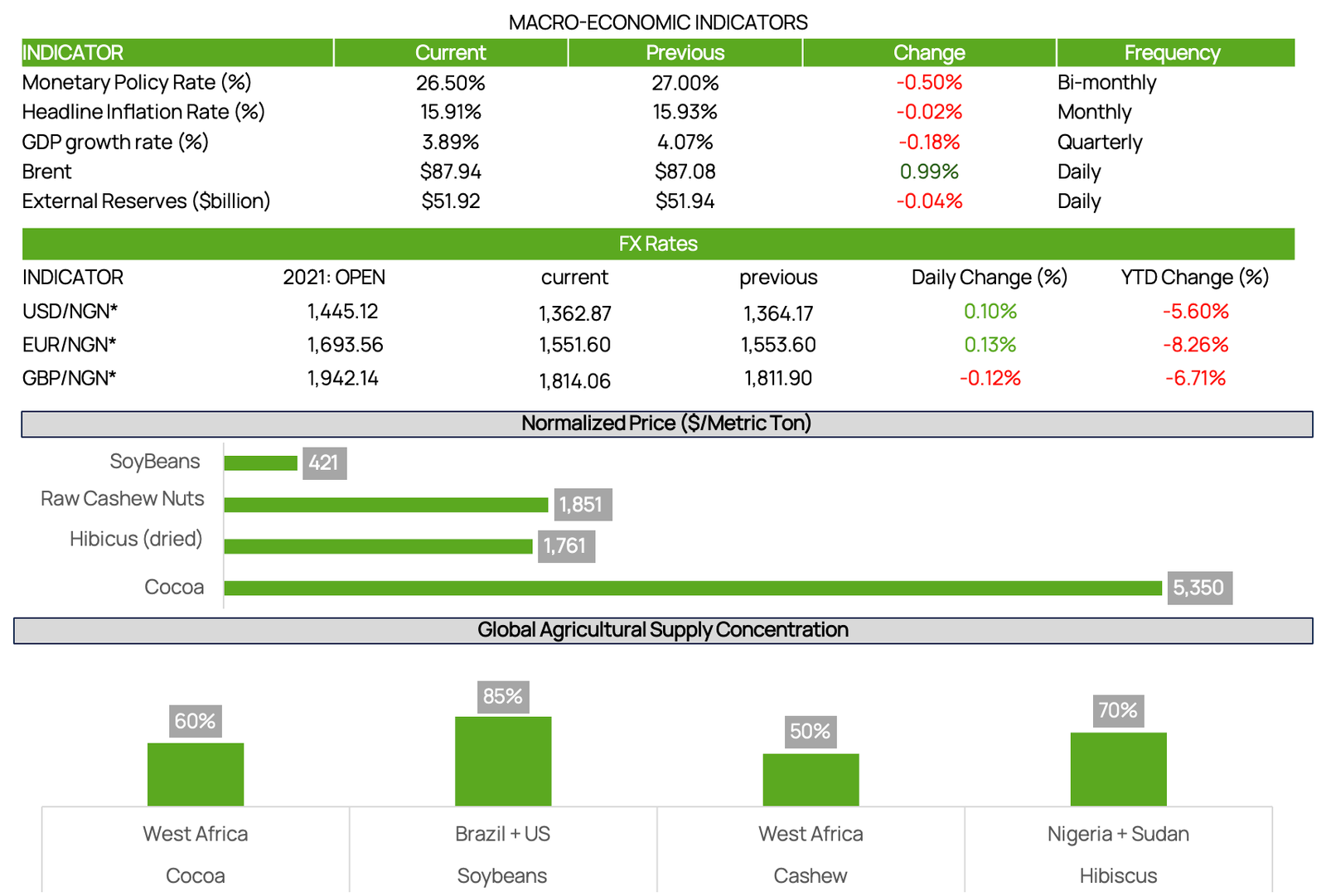
Agricultural commodity markets remained volatile again this week, with cocoa leading the move higher on renewed concerns over West African supply before easing from its highs. Soybeans remained under pressure as expectations of strong U.S. production weighed on prices, while RCN and hibiscus stayed broadly stable through the review period.
Soybeans extended their weakness as favourable U.S. crop conditions and expectations of ample global supply continued to cap prices. Strong production prospects ahead of the new
U.S. harvest kept buyers cautious, while large inventories and steady export availability reinforced the bearish tone across the oilseed complex.
The national average Cash Bean market also remained under pressure as favourable Midwest weather supported expectations for another sizeable U.S. soybean crop. With supply prospects improving and demand failing to generate a stronger upside catalyst, the market continues to face resistance heading into the new-crop marketing period.
Cocoa remains this week’s spotlight (see slide 4). Ghana’s COCOBOD expects 2026/27 production to decline by at least 16%, citing adverse weather, El Niño conditions, swollen shoot disease, aging farms and weak pod development across key growing regions. Ivory Coast is also facing expectations of a more than 10% decline, reinforcing concerns over tighter West African supply.
The RCN market held broadly stable this week as West Africa’s extended 2026 harvest continues to wind down. Supply availability remains adequate, although late-season quality and weather-related pressures are keeping buyers selective. With regional processing capacity continuing to expand, local demand is increasingly absorbing a greater share of available production.
The dried hibiscus market remained broadly stable, with Nigerian export activity continuing across established international destinations. Recent shipment data confirms continued Nigerian supply into markets including the United States and Peru, although pricing remains highly dependent on quality, cleaning standards and shipment size.
Macro backdrop: Brent crude rose sharply as uncertainty around the Strait of Hormuz kept a geopolitical premium in energy markets. Shipping traffic through the waterway remains below normal amid stalled negotiations and fresh attacks on regional shipping, raising renewed concerns over global energy and freight costs. The naira remained relatively firm, while Nigeria’s external reserves stood at $51.29bn at the latest reported reading, up from $49.58bn previously.
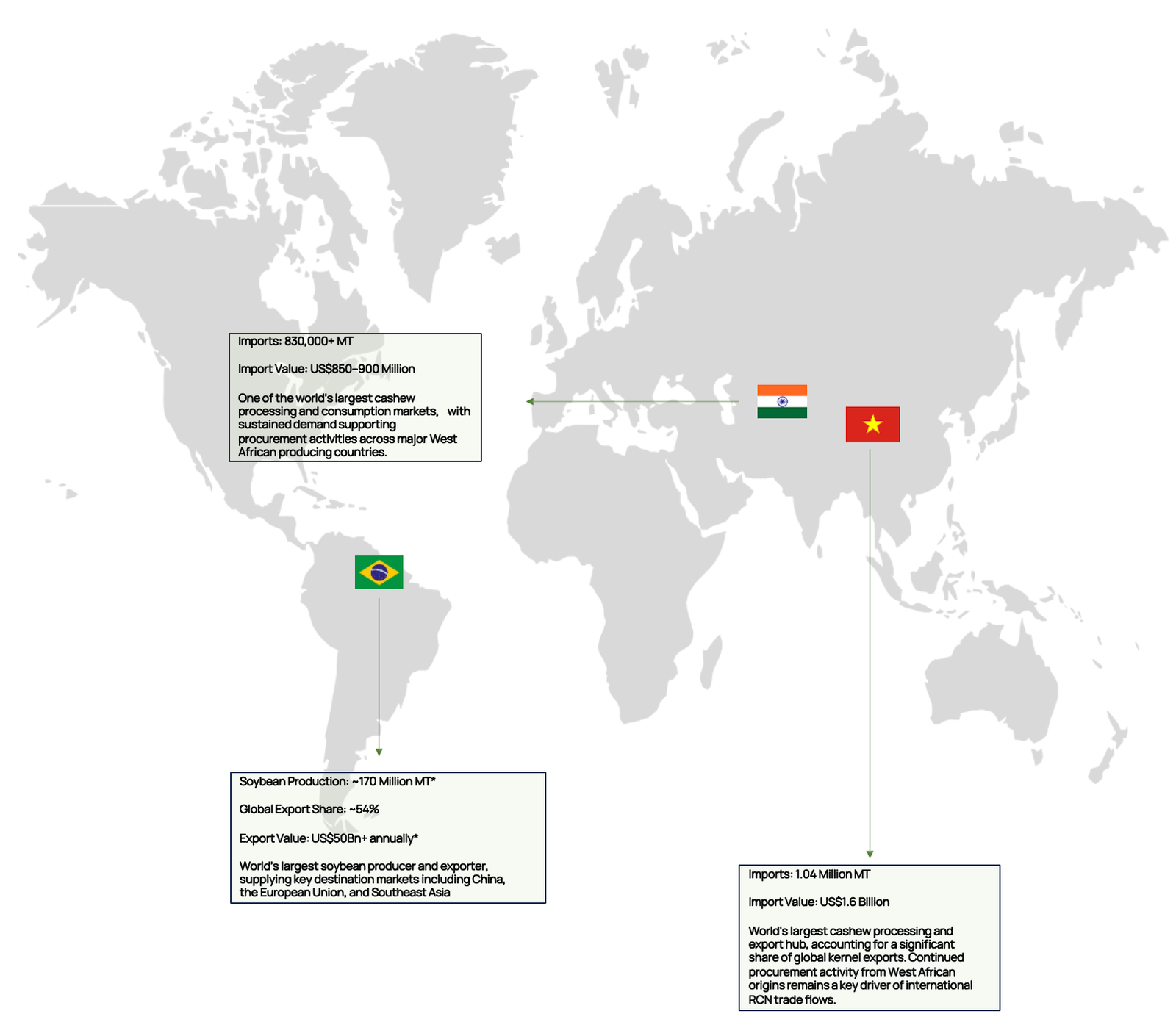
Global agricultural trade remains highly concentrated across a handful of strategic production and processing hubs. West Africa accounts for approximately two-
thirds of global cocoa production, and Ghana’s latest production warning highlights how quickly concentrated supply risks can reshape market sentiment. Meanwhile, Vietnam and India remain dominant in downstream cashew processing.
In the soybean market, Brazil and the United States continue to account for roughly 85% of global export volumes, leaving global trade highly sensitive to crop expectations and weather developments across both origins.
Meanwhile, Nigeria remains a leading origin in the global dried hibiscus trade. This concentration of supply and processing capacity keeps a few trade corridors central to global commodity flows, and the latest Ghana production concerns are another reminder of how quickly sentiment can turn when supply is concentrated across a small number of strategic origins.
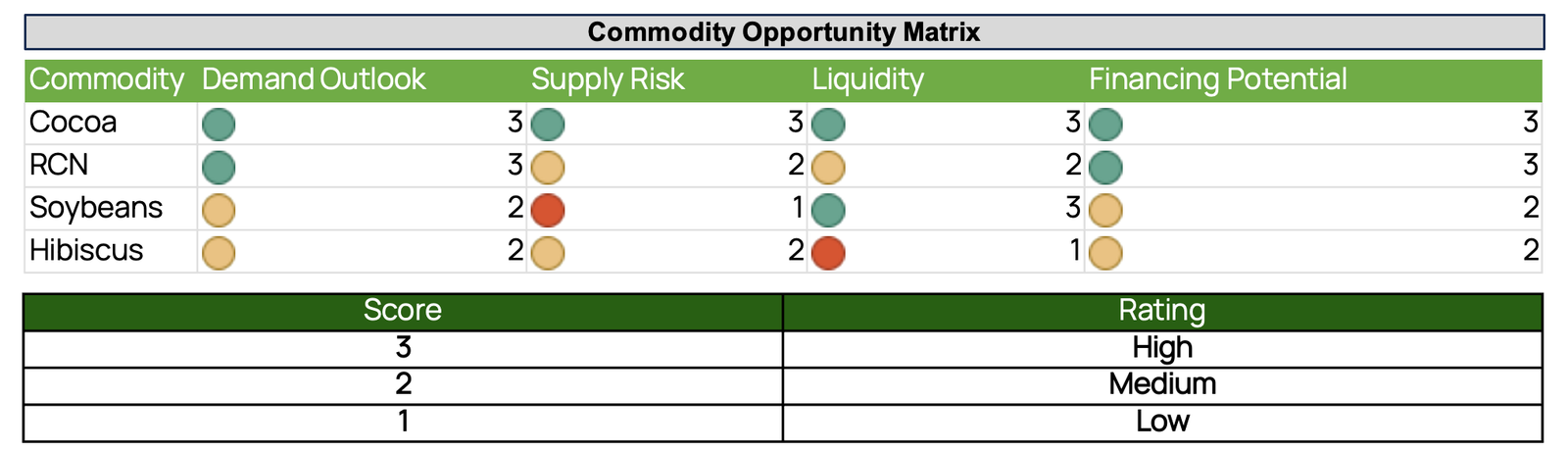
The Commodity Opportunity Matrix scores key agricultural commodities across demand outlook, supply risk, market liquidity, and financing potential. Cocoa remains the strongest opportunity this week, supported by tightening West African supply expectations, while soybeans remain constrained by ample global availability. RCN and hibiscus continue to offer selective financing opportunities as their respective seasons progress.
Cocoa remains High across all dimensions, with Ghana’s projected 2026/27 crop decline and StoneX’s sharply reduced global surplus estimate strengthening the supply-risk case. The market’s reaction reinforces the potential for price volatility and creates attractive financing conditions for quality, export-ready cocoa.
SPOTLIGHT OF THE WEEK
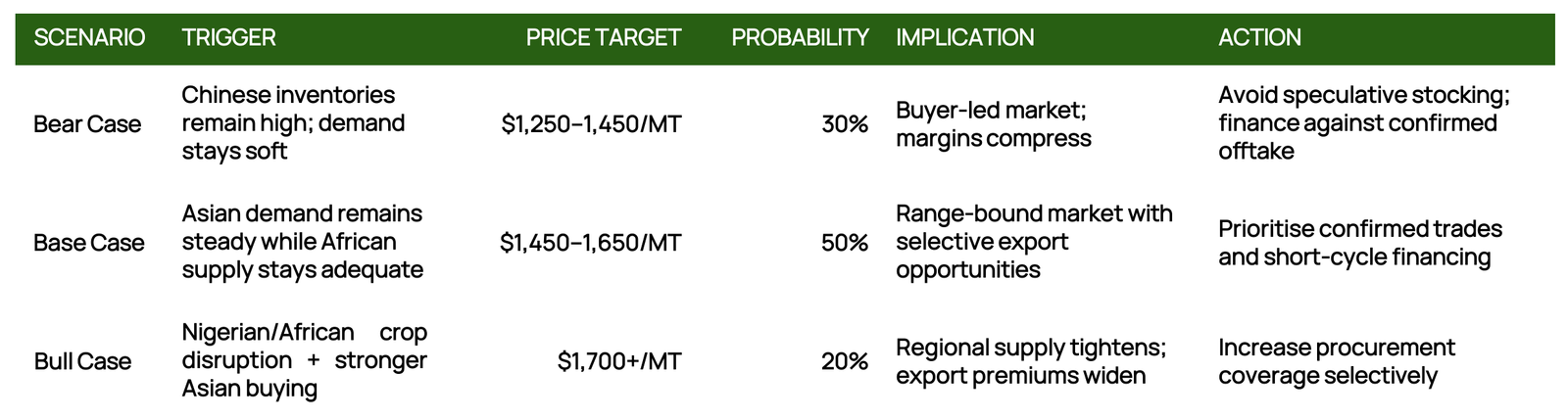
Sesame markets remained broadly range-bound this week, with ample Chinese inventories limiting upside while steady Asian demand and emerging African supply risks provided support. For Nigeria, the setup remains commercially attractive: the country is one of the world’s leading sesame exporters, with exports concentrated across China, Japan, Turkey and other Asian and Middle Eastern markets. Nigeria exported approximately $414.3 million of sesame in 2024, representing 13.9% of global exports.
Three dynamics are shaping the market:
- China’s heavy inventories cap the upside — Qingdao stocks remained elevated through the 2026 season, with earlier estimates around 361,000 MT, keeping Chinese buyers selective and limiting aggressive price appreciation. The large inventory cushion means any rally is likely to require stronger downstream demand or a meaningful disruption to African/Asian supply.
- Asian demand remains the key support — Japan’s sesame imports rose 4% y/y to 57,200 MT during January–April 2026, with Nigeria and Tanzania among the leading suppliers. South Korea also continues to provide periodic demand through government tenders, while China remains the dominant global import market.
- African supply risks are building — Nigeria’s 2026 crop faces risks from insecurity and flooding across key producing areas, while weather and geopolitical disruptions across Sudan and Mozambique could tighten regional availability later in the season. This creates potential upside risk even as global inventories remain comfortable.
Supply Fundamentals: Nigeria remains one of Africa’s largest sesame producers and exporters, with key production concentrated in Nasarawa, Jigawa, Benue, Yobe, Kano, Katsina, Kogi and Gombe. Nigerian export transactions sampled in 2026 have ranged from roughly $0.92–$1.44/kg, demonstrating significant variation by grade, destination and transaction timing. Current Nigerian export offers for cleaned seed are around $1,500/MT FOB, although actual realizations remain quality- and contract-dependent. Traceability is critical in commodity markets, ensuring transparency across the supply chain, verifying quality and origin, mitigating risks, meeting regulatory requirements.
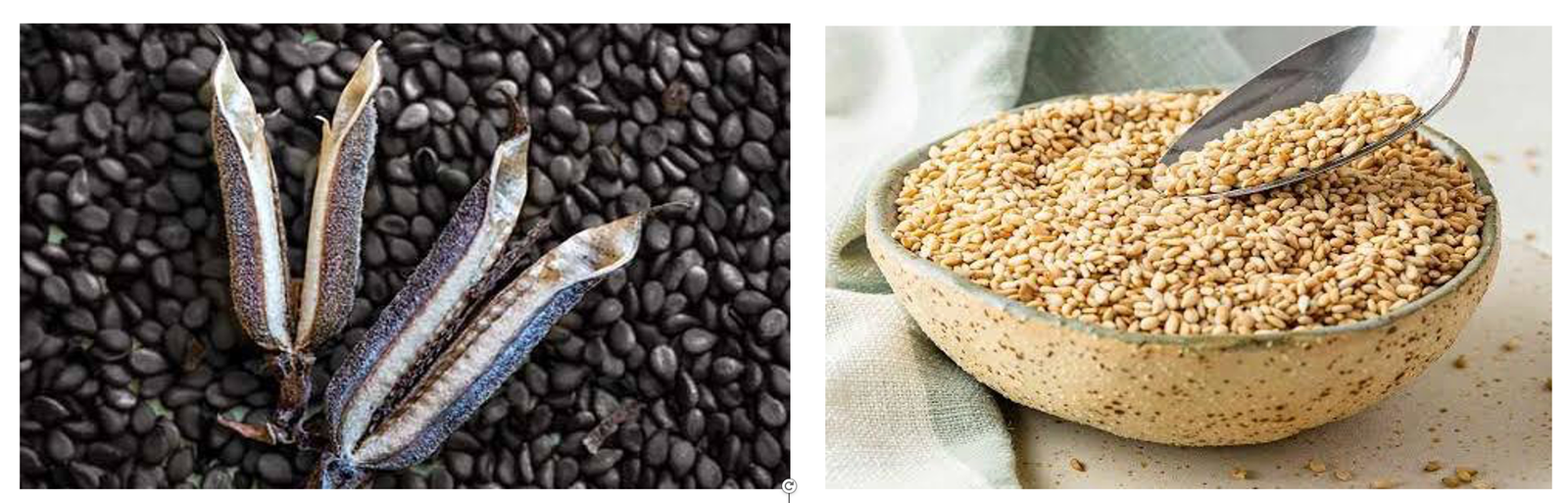
Demand Context: China remains the largest demand centre and effectively anchors global sesame pricing, while Japan, South Korea and Turkey provide important secondary demand. Japan’s higher import volumes are particularly supportive for Nigerian seed, although lower average import prices indicate that buyers remain highly price-sensitive. Quality, oil content, residue compliance and documentation are increasingly important differentiators for exporters seeking premium markets.
Trade Flow Impact: For Nigerian exporters, the current environment favours disciplined aggregation rather than aggressive inventory accumulation. The combination of relatively firm export values, established Asian demand and potential weather-related supply disruptions creates a financing opportunity where exporters have confirmed offtake, strong quality controls and short procurement-to-shipment cycles. With Nigeria’s export position already established across China, Japan and Turkey, well-structured working-capital facilities can capture seasonal margins while limiting exposure to a prolonged period of elevated Chinese inventories.