

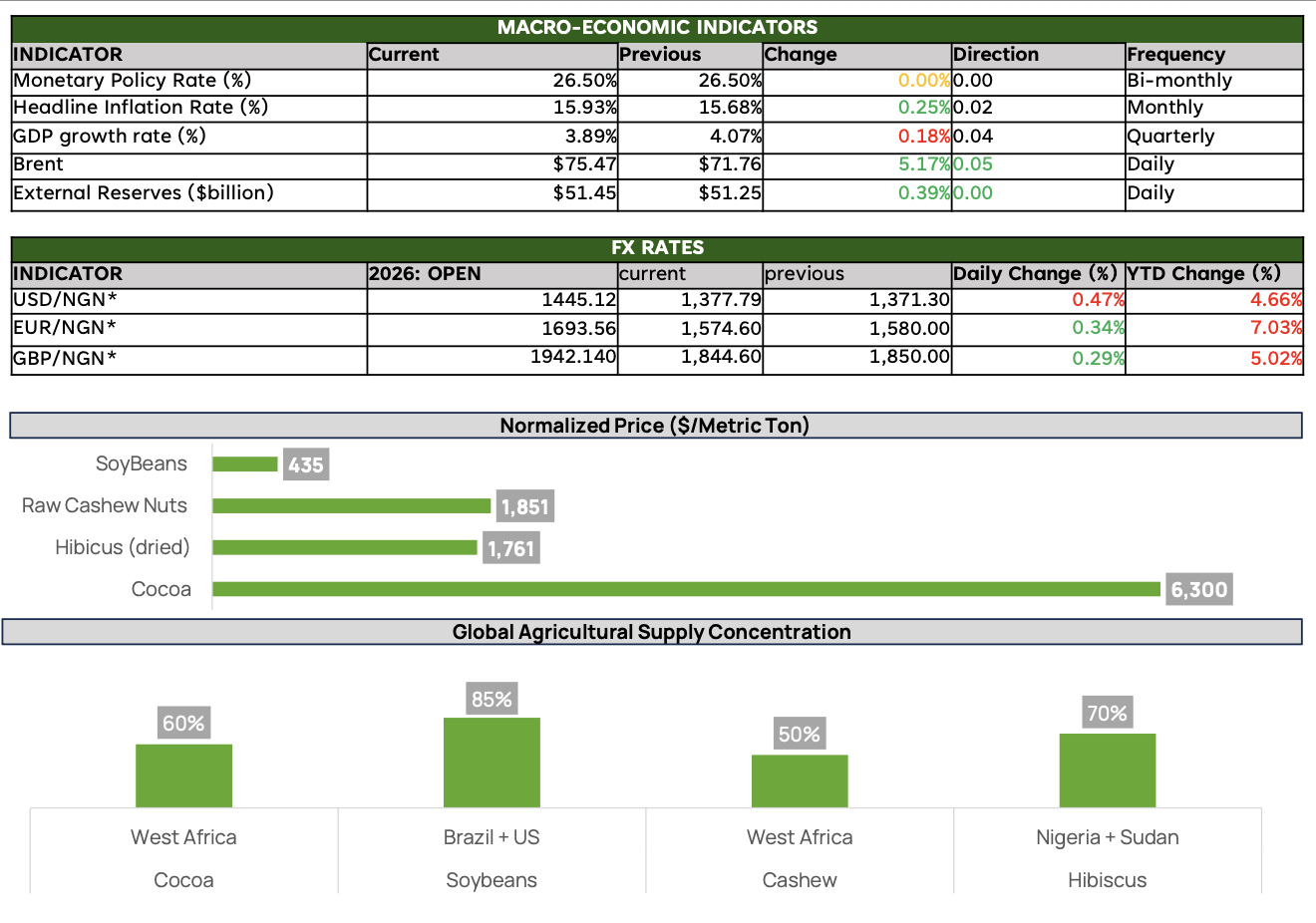
Agricultural commodity markets turned volatile this week, led by a sharp cocoa breakout. Cocoa surged to a new high near $6,300/MT (+25.6% week on week), smashing through the June 25 peak of $5,250/MT as Ivory Coast cut its 2026/27 output outlook and flooding disrupted port access.
Soybeans surged to a five-week high at $435/MT (~$11.80/bu) as renewed Chinese demand and Midwest weather risk collided with a record U.S. crop. Raw cashew markets held firm on a structurally tight 2026 West African crop, and hibiscus remained stable with steady export flow from Nigeria.
Soybean spot prices surged to $435/MT (~$11.80/bu) this week — a five-week high, up 5.9% on the month and 17.6% . Above market expectations — and 2026/27 planted acreage at 85.4 million acres (+5% y/y). That ample-supply backdrop is now being tested by today’s WASDE release and Midwest heat moving into the critical mid-July pollination window.
Cocoa broke sharply higher, gaining over 25% on the week to a new high near $6,300/MT. Côte d’Ivoire port arrivals still stand at 1.91 million MT season-to-date (+18.4% y/y), and Nigerian May cocoa exports rose +28% y/y to 18,034 MT, but that supply cushion was overwhelmed by confirmation that ICE inventories, even at a 1.75-year high of 2.95 million bags, could not offset the crop shock: early 2026/27 Ivorian crop surveys now point to just 1.7–1.8 million MT (18% y/y) after flooding and poor pod development. NOAA’s 67% odds of a “Super El Niño” compound the risk, keeping prices highly weather-sensitive into the September main crop.
The RCN market held firm as West Africa’s 2026 cashew shortfall — an estimated 200,000–250,000 MT below last year’s record — continues to filter through. Asian processors face raw-nut shortages amid temporary export bans in several African origins. Nigeria farm-gate prices held around NGN 1,800–1,950/kg, with CNF prices for 2026 still tracking $1,700–1,900/MT.
The dried hibiscus market maintained stable export flow, with Nigerian export prices holding in the $1.80–3.40/kg range. Demand growth in Turkey and Peru continues to offset softness in traditional U.S. and Mexican markets, and rain-fed planting is progressing across northern Nigeria ahead of the September–October harvest window.
MACRO BACKDROP AND WEEK AHEAD: Brent spiked to $75.47/bbl after fresh U.S. strikes on Iran reignited Strait of Hormuz supply fears, while the naira softened slightly to N1,377.79/USD and external reserves rose to $51.45 billion. Next catalysts: today’s USDA WASDE report, July cocoa crop surveys, Nigeria’s June CPI print (≈July 15), and the CBN MPC meeting (July 21–22).
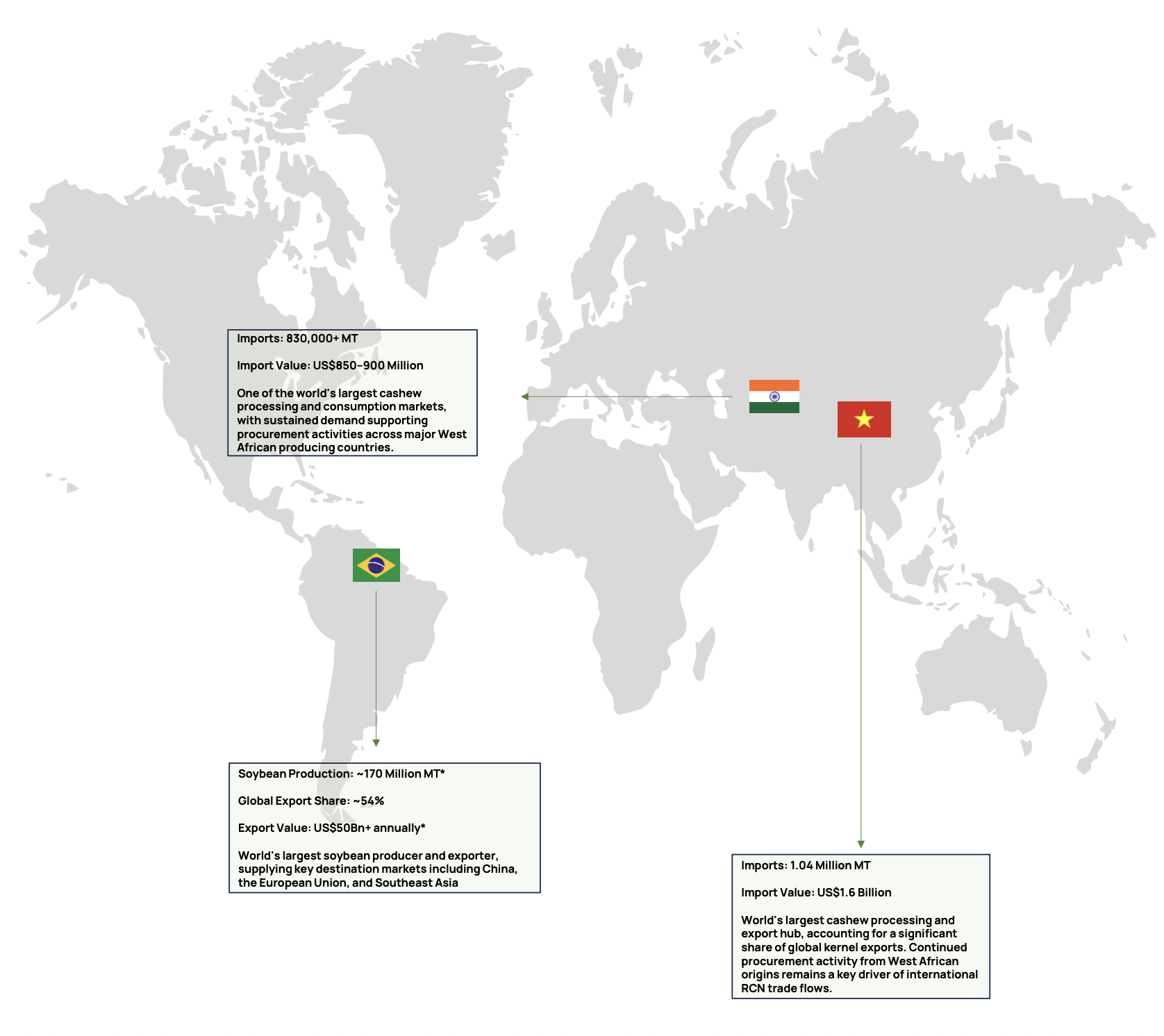
Global agricultural trade remains highly concentrated within a handful of strategic production and processing hubs. West Africa accounts for approximately 65–70% of global cocoa production — underscored by this week’s 1.91M MT of Ivorian port arrivals (+18.4% y/y) — while Vietnam and India dominate downstream cashew processing amid competition for scarce raw nuts.
In the soybean market, Brazil and the United States account for roughly 85% of global export volumes; USDA’s June 30 acreage data (+5% y/y) reinforced their influence. Meanwhile, Nigeria remains the leading origin in dried hibiscus trade, with demand broadening toward Turkey and Peru.
This concentration of supply and processing capacity keeps a few trade corridors — including the reopening Strait of Hormuz — central to global commodity flows, pricing trends, and supply chain resilience.
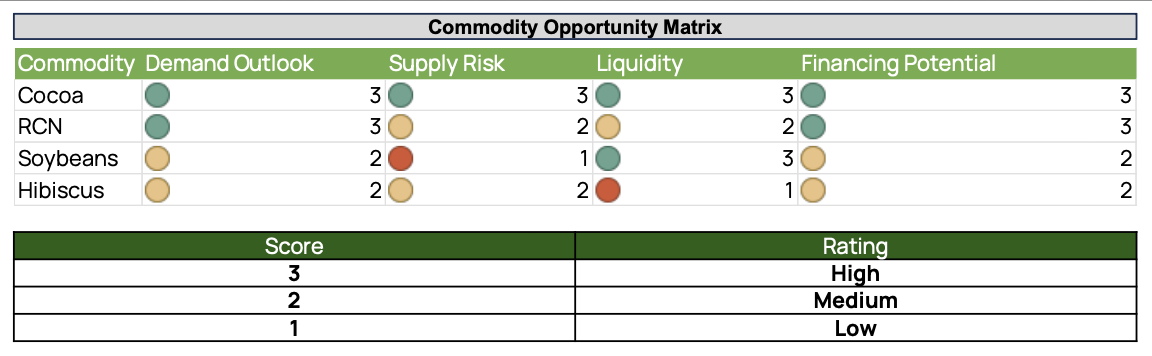
The Commodity Opportunity Matrix scores key agricultural commodities on demand outlook, supply risk, market liquidity, and financing potential. Scores are broadly steady this week: cocoa retains its maximum ratings as prices consolidate near five-month highs, and soybeans move into focus as this week’s featured opportunity on a five-week price high.
Cocoa scores High across all dimensions — consolidation below the June 25 peak (~$5,250/MT) still leaves prices up ~23% on the month, with July crop surveys and El Niño the key catalysts. RCN retains High financing potential as the 200,000–250,000 MT shortfall deepens. Soybeans move to High on liquidity and demand as Chinese buying resumes and futures hit a five-week high (see slide 4). Hibiscus holds steady on stable margins and buyer-diversification upside (Turkey, Peru).
This week marked a shift from consolidation to a breakout in grains: soybeans surged to a five-week high on renewed Chinese demand and record U.S. plantings, while cocoa held steady near five-month highs and West African crop concerns lingered.
With a “Super El Niño” still at 67% probability, the risk premium on West African-origin commodities stays elevated into H2, while Midwest weather into the July pollination window is now the dominant swing factor for grains — today’s WASDE report is the next major catalyst.
Maintain active coverage in cocoa and RCN, hold steady exposure in hibiscus into the new season, and build early positions in soybeans ahead of today’s WASDE report.