

MARKET OVERVIEW
Nigerian agro-export complex — week ended 28 August 2026
COCOA — ICE $5,806–6,117/t | +12.9% MoM | peak $6,327
- Reversed violently off the $4,992 low. StoneX cut its 2026/27 surplus from roughly 149,000t to 25,000t, leaving no cushion into the October main-crop window.
- Early Ivorian surveys show below-average cherelle formation and a 1.8 MMT main crop, down 18% YoY; record fund net-shorts turned a modest catalyst into a squeeze.
- Nigerian farmgate follows ICE with a two-to-four-week lag — forward-sold tonnage is the exposure.
CASHEW (RCN) — ~$1,350/t | 2026 season closing
- Holding near $1,350/t with the season in its final weeks; Nigerian nut still trades at a discount to Ivorian origin on outturn and moisture.
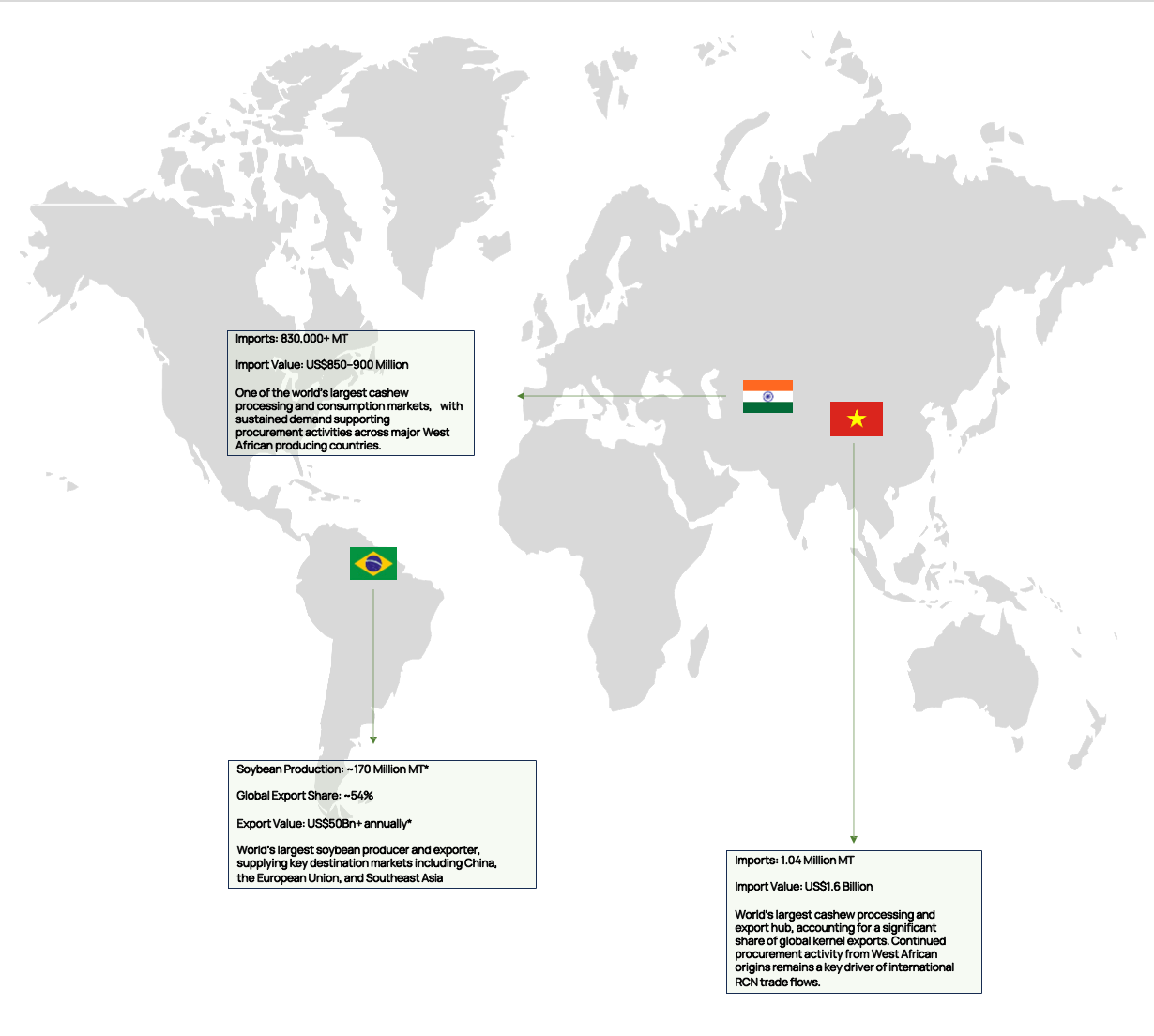
- India absorbs 830,000+ MT of imported RCN a year (US$850–900m), anchoring structural demand, while Vietnam sets the kernel price.
- Domestic processing capacity, not demand, caps value capture.
SESAME SEED — $1,700–2,030/t CNF | 98–99% purity
- Quoted at $1,700–2,030/t CNF against a 2024 average export price of $2,290/t — pricing has drifted lower and volatility remains the defining feature.
- China, Japan and India take around 60% of Nigerian export value; Cameroon and Turkey supply the offsetting import flow.
- Sortex capability and purity spec, not volume, determine realised price.
HIBISCUS — ~$1,600/t | scarce but thin
- Benchmark near $1,600/t. Nigeria and Sudan dominate exportable supply, so any Sudanese disruption transmits into price almost immediately.
- The buyer base is narrow — Mexico and EU herbal and beverage — and lot sizes are small; liquidity rather than scarcity caps the financeable ticket.
- Phytosanitary rejection is the recurring execution risk.
SOYBEAN — ~$410/t | offshore price formation
- A CBOT derivative: crush margin is a function of FX and freight rather than Nigerian fundamentals.
- A stronger naira compresses export receipts while cheapening imported inputs — broadly neutral for crushers, negative for pure exporters.
- Lowest liquidity-adjusted return in the basket.
MACRO READ-THROUGH
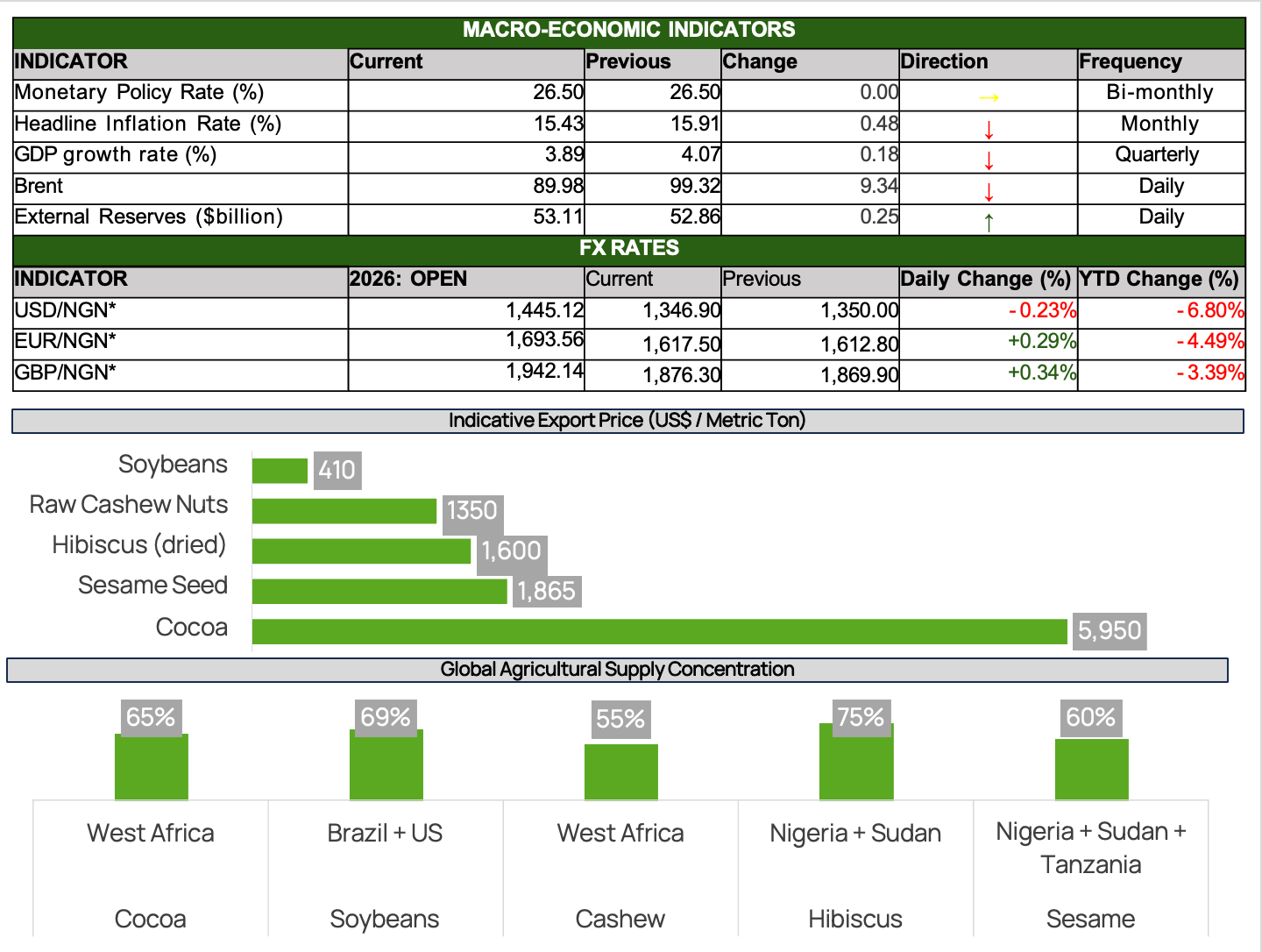
- Naira at ₦1,346.90/$ (strongest since April, 6.8% firmer YTD) with reserves at $53.11bn, a 17-year high, giving the CBN room to hold the level.
- Headline inflation eased to 15.43% but food inflation accelerated for a sixth month to 20.31% — the margin threat for processors and aggregators.
- MPR held at 26.50%, so naira working capital stays expensive; Brent near $90 keeps drying, freight and logistics costs elevated.
Regional Supply Concentration Risk
- Cocoa — Côte d’Ivoire and Ghana account for 65% of world output; a weak Ivorian main crop feeds straight into price.
- Soybean — Brazil and the US alone set 69% of traded supply. Nigeria does not influence the curve and imports the entire margin outcome.
- Cashew — West Africa supplies 55% of global RCN, but India and Vietnam control processing. Origin risk is low; offtake concentration is the real exposure.
- Hibiscus — Nigeria and Sudan hold 75% of tradeable supply against a narrow beverage and herbal buyer base — the highest two-sided concentration in the basket.
- Sesame — Roughly 60% of exportable supply sits with Nigeria, Sudan and Tanzania, while China, Japan and India take about 60% of Nigerian export value.
Concentration is the source of pricing power in cocoa and hibiscus and of fragility in soybean. Position sizing, not origin diversification, is the control.
KEY TAKEAWAY
- Additionality — cocoa and RCN clear commercial hurdles unaided. Financing value sits one layer down, in the aggregators and mid-cap processors banks will not underwrite.
- Priority — cocoa scores 9 of 9 on demand, liquidity, and financing. RCN follows at 8, held back by domestic processing capacity rather than market access.
- Impact density — sesame scores 7 and reaches the most smallholders per dollar deployed, but liquidity is the binding constraint; it suits blended or first-loss structures.
- Compliance gate — EUDR plot-level traceability is now a condition precedent for EU-bound cocoa. Portfolios without it forfeit the premium market.
- Exclusion — hibiscus at 4 and soybeans at 3 fail the liquidity and financing tests; soybean pricing is set offshore, leaving no defensible local margin.
BOTTOM LINE
- Deploy — anchor the facility in cocoa (9) and RCN (8): senior secured, self-liquidating, tenor matched to the October–March main crop.
- Structure — use concessional first-loss to open the sesame (7) and hibiscus (4) tranches that the commercial market will not price.
- Currency — draw in naira at ₦1,347/$ while the disinflation path holds; leave price risk with the off taker.
- Impact floor — covenant 60% smallholder-sourced volume and plot-level traceability, not aspirational targets.
- Monitor — food inflation at 20.31% and Brent near $90 are the two variables that turn a performing book stressed.
- Decline — no incremental soybean (3) exposure this cycle.