

Global agricultural commodity markets concluded the week with notable divergence across major export-oriented commodities, reflecting the continued interplay between weather-related supply risks, procurement activity, and evolving macroeconomic conditions. While physical grain markets remained supported by resilient international demand and improving crop prospects, soft commodities continued to exhibit significant upward momentum amid tightening supply fundamentals and heightened climatic uncertainty.
The soybean market remained broadly stable, with physical spot values consolidating around US$435/MT as market participants assessed the implications of the latest U.S. Department of Agriculture (USDA) projections. The July WASDE report reaffirmed expectations of a record
U.S. harvest, supported by favourable crop conditions and robust planting progress. Nevertheless, sustained Chinese procurement activity continues to underpin global demand, providing an important counterbalance to improving supply expectations and limiting downside pressure on international prices.
Cocoa was the week’s strongest performer, with spot prices rising to approximately US$6,523/MT, a new record high. Although port arrivals in Côte d’Ivoire and exchange inventories improved, the market remained focused on weaker 2026/27 production forecasts and the growing threat of El Niño across West Africa. Given the region’s dominant share of global cocoa production, weather-related risks continue to underpin elevated price levels.
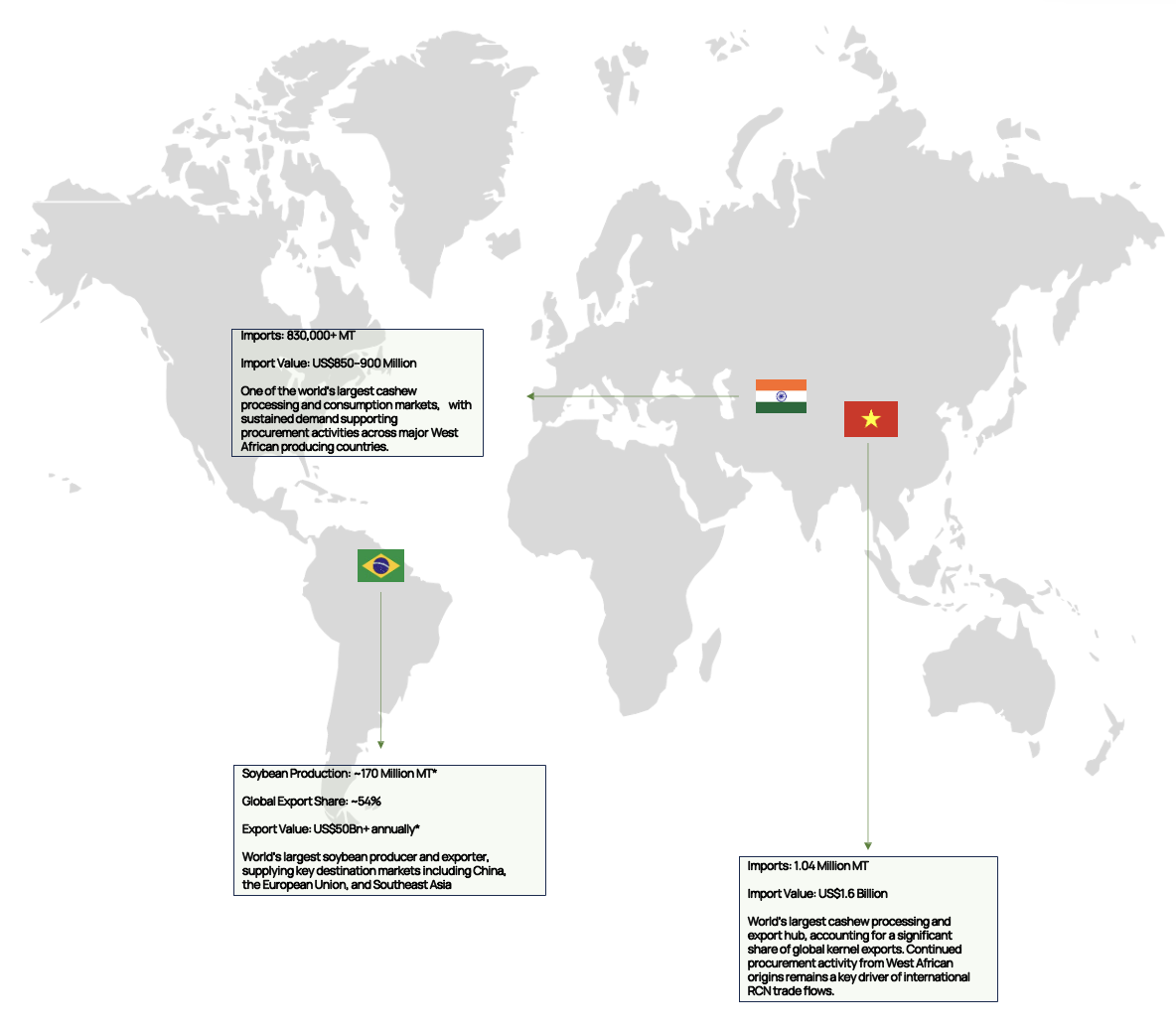
The Raw Cashew Nut (RCN) market remained firm as lower crop expectations across West Africa tightened supply. Active procurement by processors in Vietnam and India continued to support international prices, while Nigerian farm-gate prices and CNF quotations remained elevated.
The dried hibiscus market remained stable, supported by steady export demand and favourable planting conditions across northern Nigeria. Demand from emerging markets continued to offset softer activity in some traditional destinations.
From a macroeconomic perspective, Brent crude strengthened on renewed geopolitical tensions, while the Naira remained relatively stable against the U.S. Dollar despite a slight moderation in external reserves. Looking ahead, market participants will closely monitor weather developments, crop assessments, and key macroeconomic releases as the primary drivers of commodity pricing and trade activity in the weeks ahead. These developments are expected to influence procurement strategies, working capital requirements, and structured trade finance opportunities across agricultural value chains.
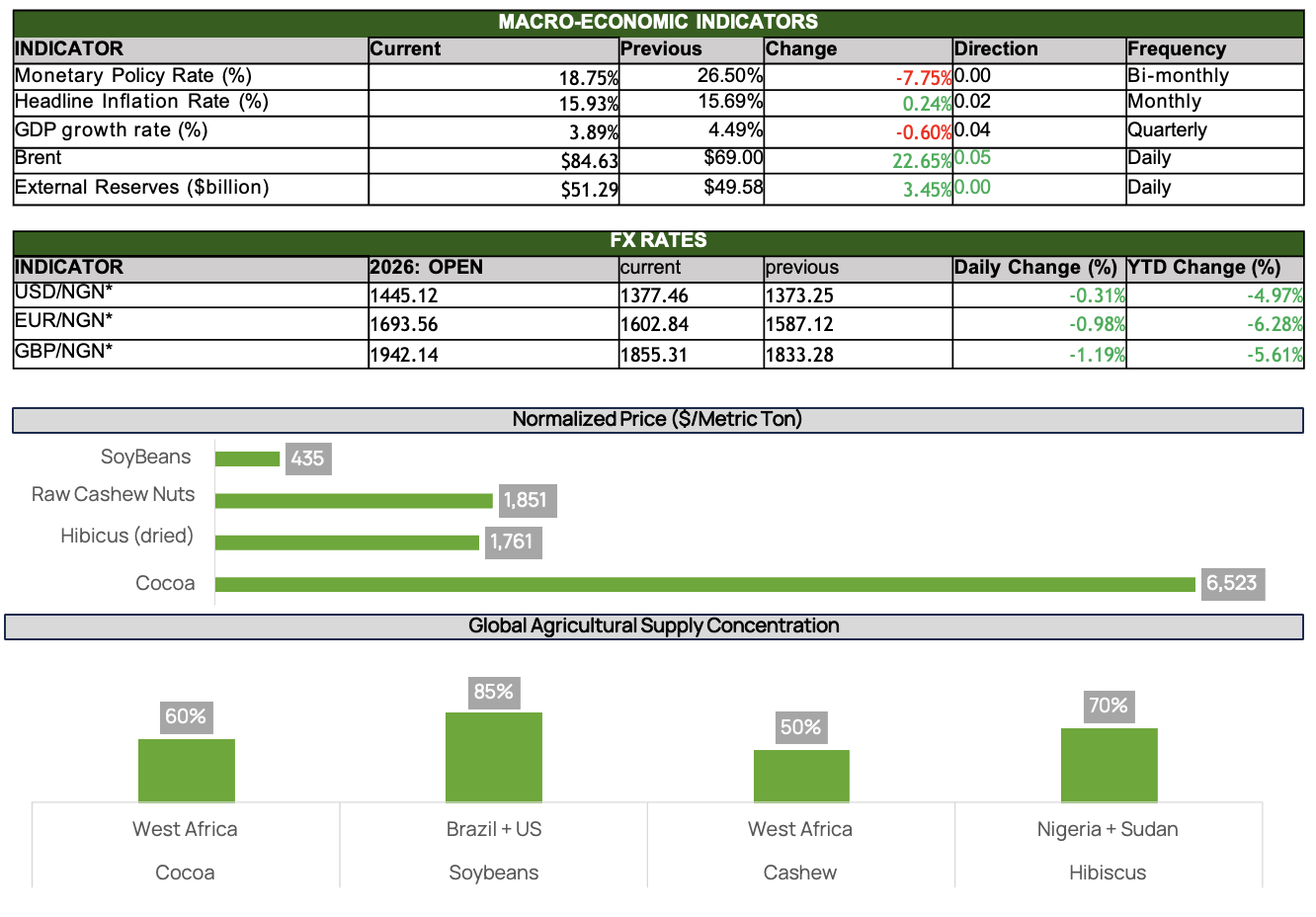
Global agricultural trade remains concentrated in a limited number of strategic production and processing hubs, reinforcing the structural importance of key commodity corridors. West Africa remains the dominant cocoa-producing region, accounting for approximately 65–70% of global output, while ongoing weather-related risks and tightening supply continue to support elevated international prices.
In the cashew market, Vietnam and India remain the world’s principal processing centers, competing aggressively for raw cashew nuts amid a tighter West African crop. Meanwhile, Brazil and the United States continue to account for approximately 85% of global soybean exports, with the latest USDA outlook reaffirming their influence on global supply and price formation. Nigeria also remains a leading supplier of dried hibiscus, supported by expanding demand across emerging export destinations.
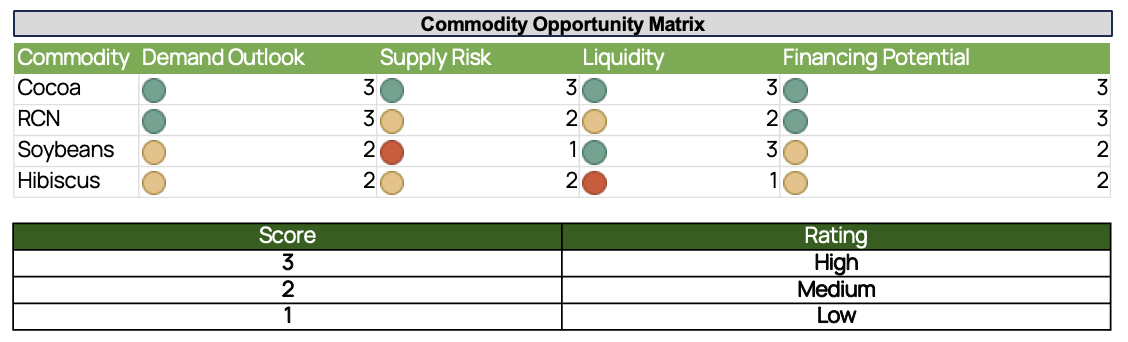
The Commodity Opportunity Matrix scores key agricultural commodities on demand outlook, supply risk, market liquidity, and financing potential. Scores tightened further this week: cocoa retains maximum ratings as prices hit new all-time highs, while soybeans hold steady on a five-week price plateau.
Cocoa scores High across all dimensions — the break above $6,523/MT leaves prices up ~33% on the month, with crop surveys and El Niño the key catalysts. RCN retains High financing potential as the 200,000–250,000 MT shortfall deepens. Soybeans hold High on liquidity as Chinese buying continues (see slide 4). Hibiscus holds steady on planting progress and buyer diversification.
This week marked cocoa’s decisive breakout to new all-time highs, while grains held their five-week plateau and West African crop concerns intensified across cocoa and cashew alike.
With a Super El Niño now at 96% probability, the risk premium on West African-origin commodities is likely to stay elevated through the September main crop, while Midwest weather remains the dominant swing factor for grains.
Maintain active coverage in cocoa and RCN, hold steady exposure in hibiscus into the new season, and monitor soybean weather risk into August crop development.
COMMODITY SPOTLIGHT: COCOA.
Cocoa spot prices broke to a new all-time high above $6,523/MT this week, extending last week’s record, up 3.5% on the week and 33% over the past month. Global supply remains critically tight — Côte d’Ivoire’s 2026/27 crop is now tracking to just 1.7–1.8 million MT — but three dynamics are driving the tape:
1.El Niño risk hits 96% — the WMO now assigns a 96% probability of Super El Niño through early 2027, the highest ever recorded at this stage, with historical events tied to 30–50% West African output declines.
2.Crop surveys confirm the shock — early 2026/27 Ivorian surveys point to 1.7–1.8 million MT, down 18% y/y, even as season-to-date port arrivals of 1.91 million MT (+18.4% y/y) offered a false sense of near-term supply comfort.
3.European demand is cracking — Q2 grindings fell 4.6% y/y to 316,366 MT, the lowest Q2 on record, confirming processors are already rationing volume at current price levels.
Supply Fundamentals: West Africa supplies 65–70% of world cocoa from smallholder farms with aging trees, leaving little buffer against weather shocks. Côte d’Ivoire and Ghana face simultaneous 2026/27 declines, and ICE stocks at 2.95 million bags — a 1.75-year high — still cannot offset a crop shortfall of this scale.
Demand Context: Global chocolate demand keeps growing in Asia and premium segments, but at $6,523/MT processors are far outside the historical $2,300–2,800/MT comfort zone. The 4.6% grinding decline shows demand destruction is real, but supply — not demand — will decide where prices settle.
Trade Flow Impact: Ghana’s COCOBOD and Côte d’Ivoire’s controlled farmgate systems mean higher global prices raise trade finance and working capital needs more than farmer income. For Nigerian exporters, cocoa is now a record-high revenue opportunity: at current FX, $6,523/MT converts to roughly ₦9.0 million per MT — the highest naira-equivalent export value on record for this commodity.
Overall, the cocoa market has transitioned from a cyclical supply imbalance to a structurally constrained environment where weather developments, production forecasts, and inventory trends are likely to exert a disproportionate influence on price formation.


H2 2026 Cocoa Price Scenarios:
BEAR — El Niño proves moderate, 2026/27 crop recovers toward 2.0 million MT; prices correct to $4,800–5,400/MT (25% probability).
BASE — Super El Niño confirmed, crop holds at 1.7–1.8 million MT; prices consolidate at $5,800–7,200/MT on persistent deficit (50% probability).
BULL — severe West African dry season follows harvest
failure; crop falls below 1.5 million MT; prices retest
$9,000+/MT (25% probability).
Key Takeaway: Cocoa is 2026’s highest-conviction supply trade. This week’s all-time high is not the peak — it’s the new base case. With El Niño at 96% and a confirmed 18% crop decline, we favor the $5,800–7,200/MT range as the planning assumption for Q3–Q4 procurement.