

WEEK IN REVIEW — PRICE, POSITIONING & BASIS
Week ending 4 September 2026 · Equinorth Capital Commodities Weekly · West Africa agri complex
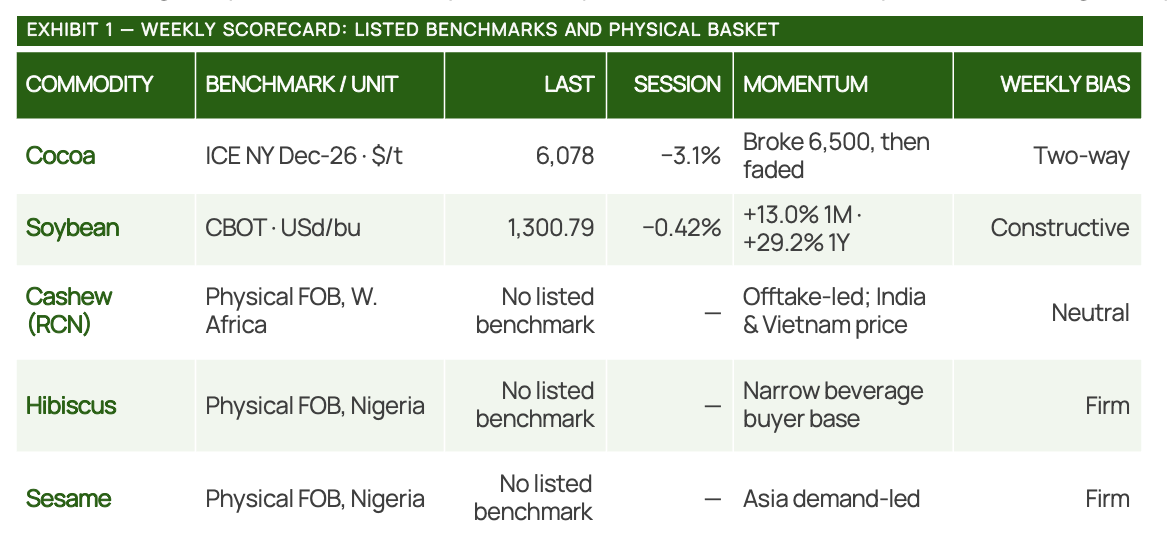
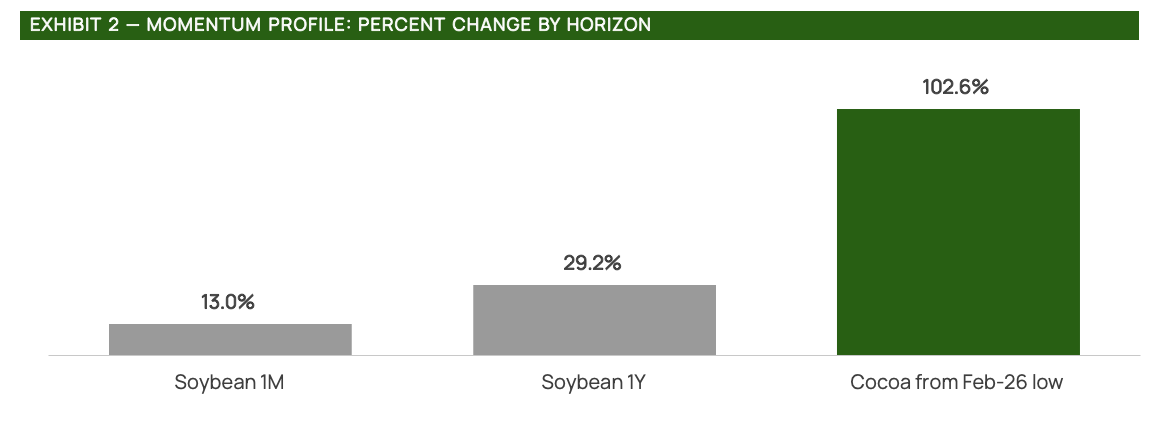
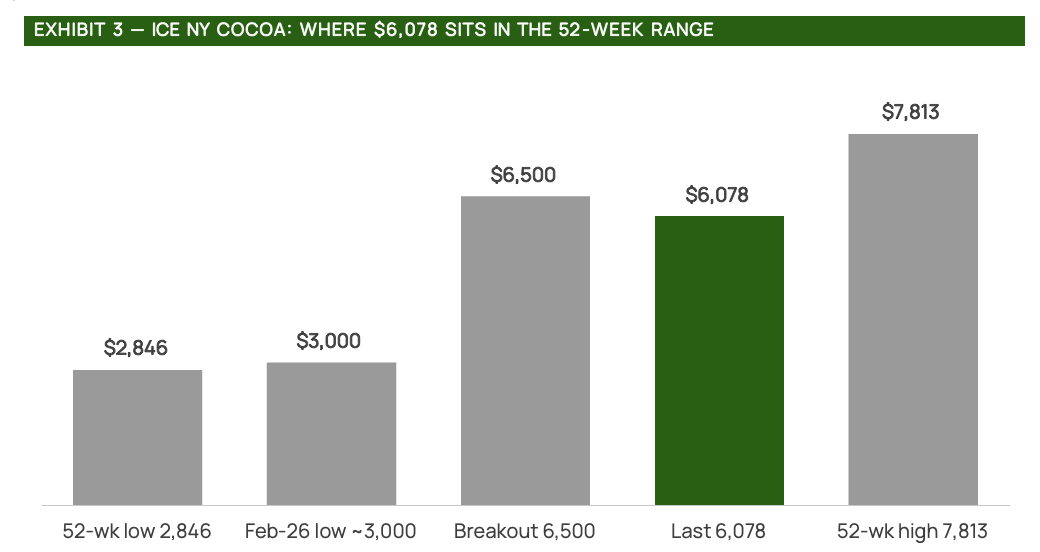
EXHIBIT 4 — WHAT MOVED THE WEEK
- Cocoa — Dec-26 broke above $6,500 on El Niño risk and a shrinking 2026/27 surplus, then gave back 3.1% to $6,078 as the formal season opening collided with confirmed Ivorian supply. StoneX now carries a surplus of roughly 25kt.
- Structural — Côte d’Ivoire targets 1.3 MMT of grinding capacity in 2026/27 against 650kt in 2025/26. Origin value capture rises; exportable bean supply falls.
- Soybean — Held above $13/bu, the highest since December 2023, on 530kt of Chinese purchases announced since 1 September against a 25 MMT annual commitment through 2028. New-crop outstanding sales stand at 16.28 MMT.
- Physical basket — Cashew, hibiscus and sesame carry no listed hedge. Weekly marks are offtake-driven, so the live exposure is buyer concentration rather than price discovery.
- Positioning — Cocoa is a two-way trade into the next West African crop surveys; soybean momentum is policy-dependent on the late-September US-China agricultural talks.
Source: ICE Futures US, CBOT, USDA, StoneX and exchange settlement data as at 4 September 2026. Physical FOB levels are indicative and non-tradeable. For institutional use only — not investment advice.
MARKET OVERVIEW
Nigerian agro-export complex — week ended 4 September 2026
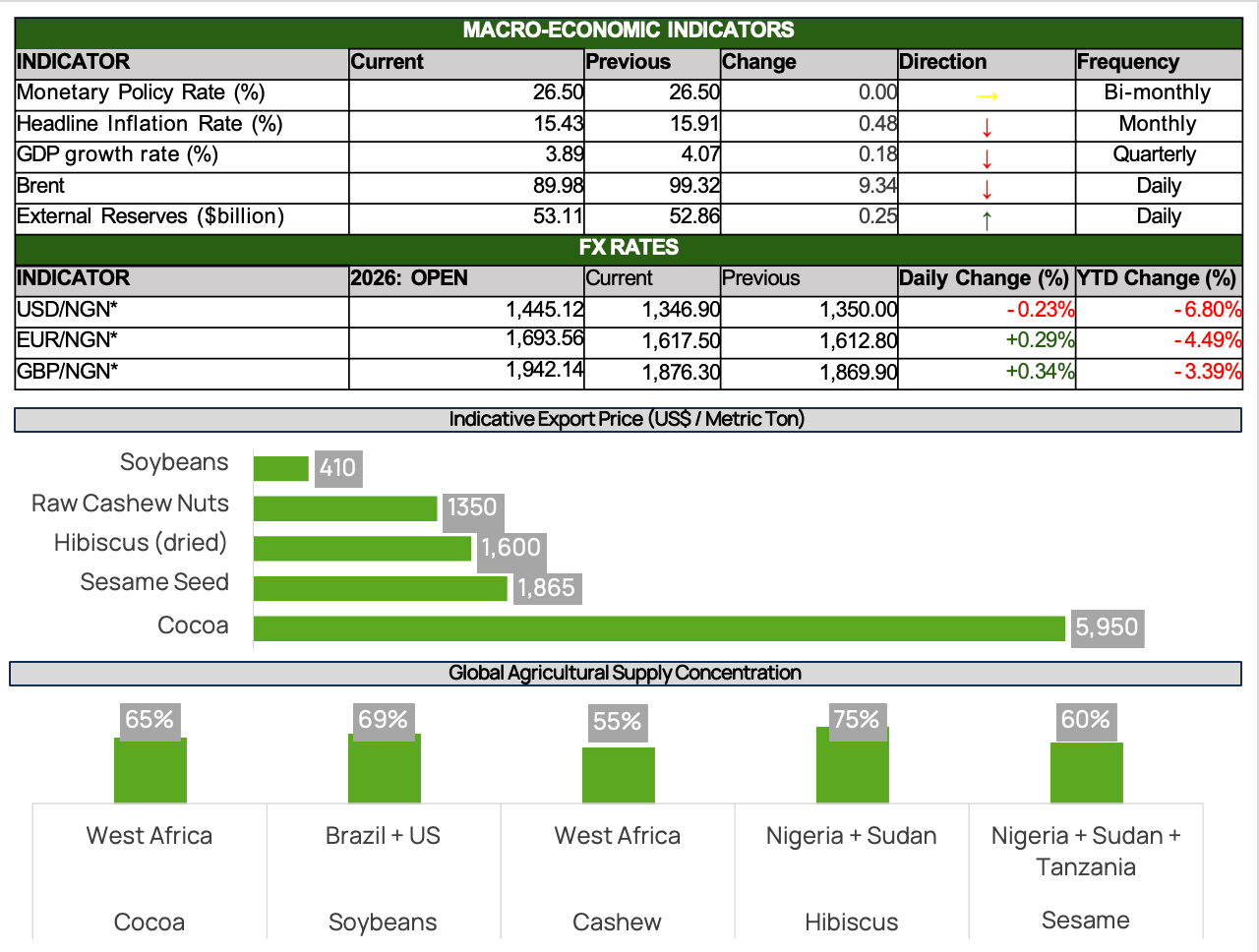
COCOA — ICE $5,806–6,117/t | +12.9% MoM | peak $6,327
- Reversed violently off the $4,992 low. StoneX cut its 2026/27 surplus from roughly 149,000t to 25,000t, leaving no cushion into the October main-crop window.
- Early Ivorian surveys show below-average cherelle formation and a 1.8 MMT main crop, down 18% YoY; record fund net shorts turned a modest catalyst into a squeeze.
- Nigerian farmgate follows ICE with a two-to-four-week lag — forward-sold tonnage is the exposure.
CASHEW (RCN) — ~$1,350/t | 2026 season closing
- Holding near $1,350/t with the season in its final weeks; Nigerian nut still trades at a discount to Ivorian origin on outturn and moisture.
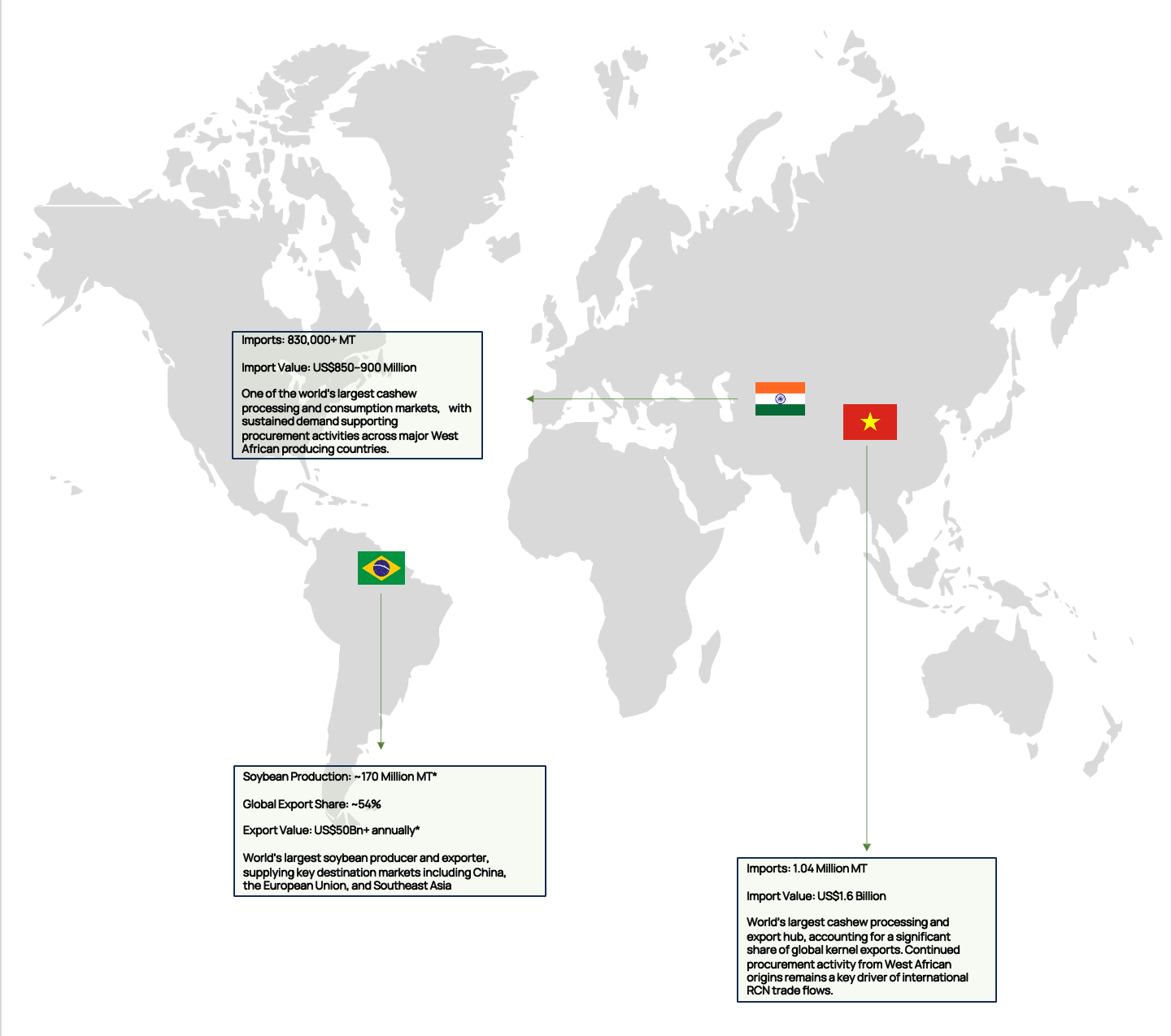
- India absorbs 830,000+ MT of imported RCN a year (US$850–900m), anchoring structural demand, while Vietnam sets the kernel price.
- Domestic processing capacity, not demand, caps value capture.
SESAME SEED — $1,700–2,030/t CNF | 98–99% purity
- Quoted at $1,700–2,030/t CNF against a 2024 average export price of $2,290/t — pricing has drifted lower, and volatility remains the defining feature.
- China, Japan and India take around 60% of Nigerian export value; Cameroon and Turkey supply the offsetting import flow.
- Sortex capability and purity spec, not volume, determine realised price.
HIBISCUS — ~$1,600/t | scarce but thin
- Benchmark near $1,600/t. Nigeria and Sudan dominate exportable supply, so any Sudanese disruption transmits into price almost immediately.
- The buyer base is narrow — Mexico and EU herbal and beverage — and lot sizes are small; liquidity rather than scarcity caps the financeable ticket.
- Phytosanitary rejection is the recurring execution risk.
SOYBEAN — ~$410/t | offshore price formation
- A CBOT derivative: crush margin is a function of FX and freight rather than Nigerian fundamentals.
- A stronger naira compresses export receipts while cheapening imported inputs — broadly neutral for crushers, negative for pure exporters.
- Lowest liquidity-adjusted return in the basket.
MACRO READ-THROUGH
- Naira at ₦1,346.90/$ (strongest since April, 6.8% firmer YTD) with reserves at $53.11bn, a 17-year high, giving the CBN room to hold the level.
- Headline inflation eased to 15.43%, but food inflation accelerated for a sixth month to 20.31% — the margin threat for processors and aggregators.
- MPR held at 26.50%, so naira working capital stays expensive; Brent near $90 keeps drying, freight and logistics costs elevated.
-
Source: ICCO/Trading Economics, USDA, StoneX Commodity-Board, CBN, NgnRates.com WMO-World Meteorological Organization, WASDE — World Agricultural Supply and Demand Estimates
Regional Supply Concentration Risk
- Cocoa — Côte d’Ivoire and Ghana account for 65% of world output; a weak Ivorian main crop feeds straight into price. Dec-26 fell 3.1% this week to $6,078 from above $6,500.
- Soybean — Brazil and the US alone set 69% of traded supply. Nigeria has no influence on the curve and imports the entire margin outcome — at $13.00/bu and +29.2% year on year, that import is now expensive.
- Cashew — West Africa supplies 55% of global RCN, but India and Vietnam control processing. Origin risk is low; offtake concentration is the real exposure.
- Hibiscus — Nigeria and Sudan hold 75% of tradeable supply against a narrow beverage and herbal buyer base — the highest two-sided concentration in the basket.
- Sesame — Roughly 60% of exportable supply sits with Nigeria, Sudan and Tanzania, while China, Japan and India take about 60% of Nigerian export value.
Concentration is the source of pricing power in cocoa and hibiscus and of fragility in soybean. Côte d’Ivoire’s 1.3 MMT grind target moves power upstream. Position sizing, not origin diversification, is the control.
KEY TAKEAWAY
- Additionality — cocoa and RCN clear commercial hurdles unaided. Financing value sits one layer down, in the aggregators and mid-cap processors banks will not underwrite.
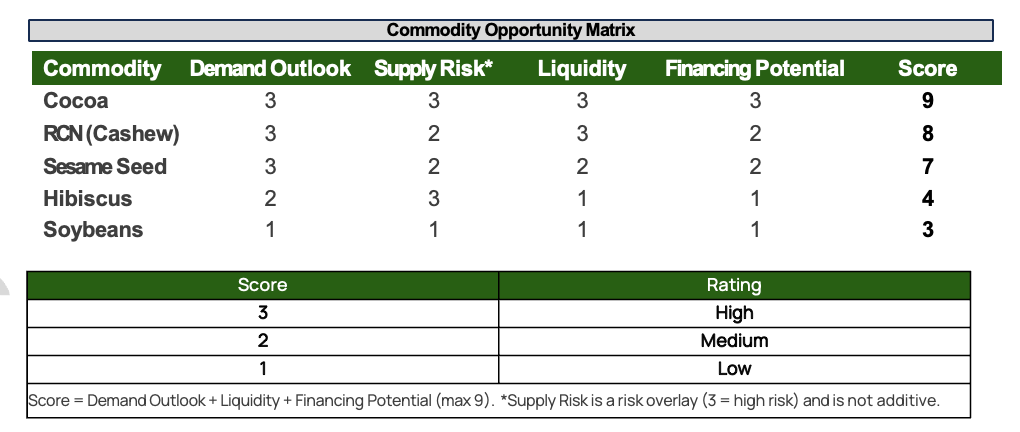
- Priority — cocoa scores 9 of 9 on demand, liquidity, and financing. RCN follows at 8, held back by processing capacity; Côte d’Ivoire’s 1.3 MMT grind target is the read-across.
- Impact density — sesame scores 7 and reaches the most smallholders per dollar deployed, but liquidity is the binding constraint; it suits blended or first-loss structures.
- Compliance gate — EUDR plot-level traceability is now a condition precedent for EU-bound cocoa. Portfolios without it forfeit the premium market.
- Exclusion — hibiscus at 4 and soybeans at 3 fail the liquidity and financing tests; soybean pricing is set offshore, leaving no defensible local margin.
BOTTOM LINE
- Deploy — anchor the facility in cocoa (9) and RCN (8): senior secured, self-liquidating, advance rates struck off $5,500, not $6,078 spot.
- Structure — use concessional first-loss to open the sesame (7) and hibiscus (4) tranches the commercial market will not price.
- Currency — draw in naira at ₦1,347/$ while the disinflation path holds; leave price risk with the offtaker.
- Impact floor — covenant 60% smallholder-sourced volume and plot-level traceability, not aspirational targets.
- Monitor — food inflation at 20.31%, Brent near $90 and a 25kt cocoa surplus turn a performing book stressed.
- Decline — no incremental soybean (3) exposure at $13.00/bu, +29.2% y/y.