

Agricultural commodity markets delivered a sharp divergence this week. Cocoa spot prices surged +18.5% week on week to $4,973/MT — a 5.5-month high — driven by a violent supply- driven spot price rally as West African flooding and confirmed El Niño formation shook markets. Soybeans fell to four-month lows near $10.60/bu (~$390/MT) on ample U.S. crop conditions and record Brazil planting forecasts. Raw cashew markets held firm on a structurally tight 2026 West African crop, estimated 200,000–250,000 MT below last year’s record. Hibiscus remained stable with steady export flow from Nigeria.
Soybean cash prices hit fresh four-month lows near $10.60/bu this week, extending a 6.6% monthly decline. USDA’s June WASDE held U.S. 2026/27 soybean production forecasts at 4.435 billion bushels — the second-largest crop on record — with 66% good-to-excellent crop ratings unchanged week-on-week. Brazil’s planted area is projected to reach a record 49 million hectares in 2026/27.
Cocoa was the standout mover of the week. The ICCO daily spot price surged to $4,973/MT on June 24 — a 5.5-month high — driven by three converging factors: severe flooding in Côte d’Ivoire and Ghana (June rainfall already near full-month averages by mid-week) disrupted farm access and port logistics; Japan’s Meteorological Agency confirmed El Niño formation, with NOAA estimating a 67% probability of a “Super El Niño”; and reduced physical supply availability drove spot prices sharply higher.
The RCN market held firm as the structural consequences of West Africa’s 2026 cashew shortfall continue to filter through. The season is tracking 200,000–250,000 MT below last year’s record, with shortfalls spread across Côte d’Ivoire, Ghana, Nigeria, and Benin. Local processors in Côte d’Ivoire alone absorbed ~637,000 MT, leaving exporters competing intensely for the remaining stock. Vietnam raised W320 kernel offers by $0.10–0.15/lb in response to firm RCN costs. Nigeria farm-gate prices held around NGN 1,800–1,950/kg, though port congestion at Lagos is causing short-term export delays. CNF prices for 2026 are tracking $1,700–1,900/MT.
The dried hibiscus market maintained a stable export flow. Nigeria accounts for the majority of the global dried hibiscus supply, exporting an estimated 80,000–100,000 MT annually. Export prices have declined from a 2023 range of $2.60–4.40/kg to a current range of $1.80–3.40/kg, reflecting supply-side normalization. Demand is growing in Turkey and Peru (+331.7% YoY), partly offsetting softness in traditional U.S. and Mexican markets. June planting (the primary season) is now underway in northern Nigeria with the next major harvest window expected September–October.
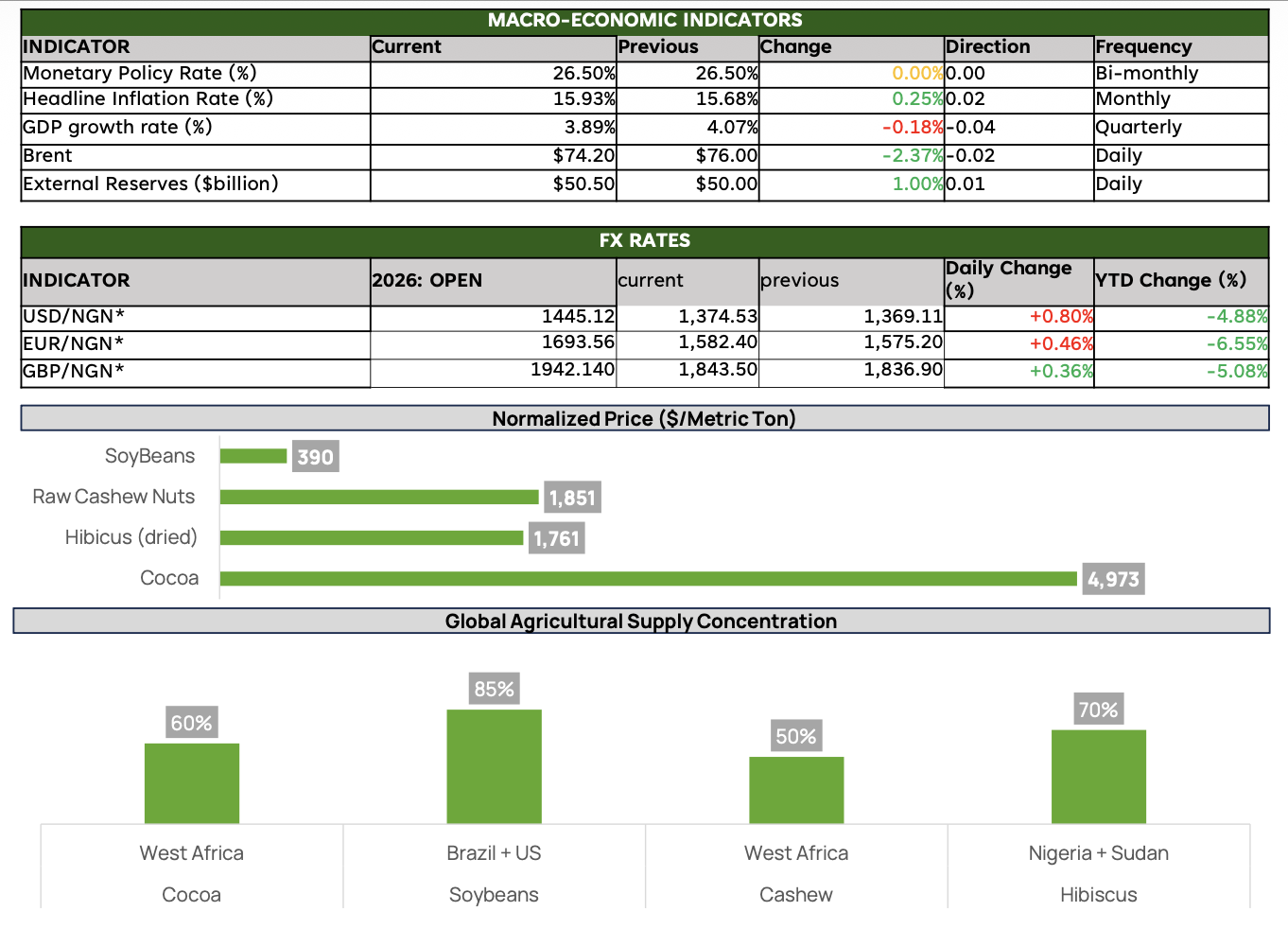
Global agricultural trade remains highly concentrated within a handful of strategic production and processing hubs. West Africa accounts for approximately 65–70% of global cocoa production and remains a key supplier of raw cashew nuts, while Vietnam and India dominate downstream cashew processing and value addition. In the soybean market, Brazil and the United States account for roughly 85% of global export volumes, reinforcing their influence on global supply dynamics. Meanwhile, Nigeria continues to play a significant role in the international dried hibiscus trade. The concentration of supply and processing capacity across a limited number of markets highlights the importance of these trade corridors in shaping global commodity flows, pricing trends, and supply chain resilience.
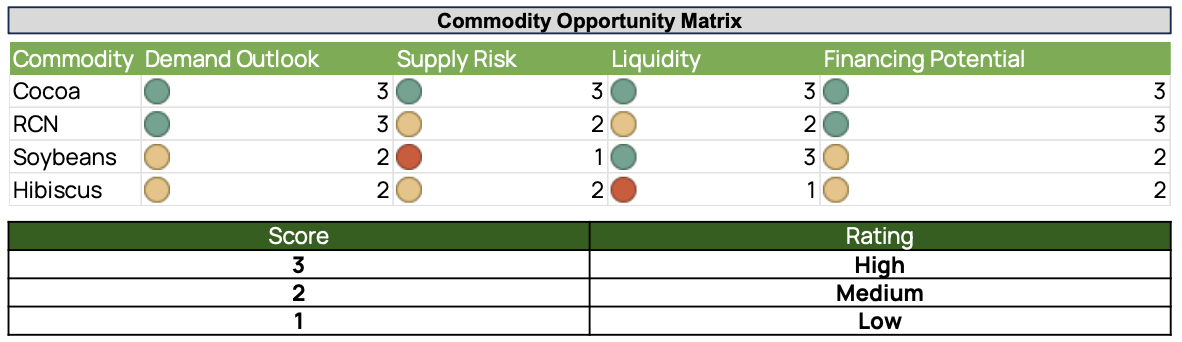
The Commodity Opportunity Matrix scores key agricultural commodities on demand outlook, supply risk, market liquidity, and financing potential. This week’s scores reflect a significantly changed landscape from prior weeks, with cocoa upgraded to maximum scores across all four dimensions following its explosive price re-rating, and soybeans downgraded on liquidity risk as price momentum turns decisively bearish. Cocoa scores High across all dimensions: a confirmed El Niño, catastrophic West African flooding, and a short-covering-driven 18.5% weekly spot price gain make it the highest-conviction trade of the quarter. RCN retains High financing potential as the 200,000–250,000 MT crop shortfall deepens. Soybeans retain High liquidity but are Medium on demand and Low on supply risk, given record projected output. Hibiscus remains broadly Medium — stable but not headline-moving, with the next catalyst being September-October harvest outcomes
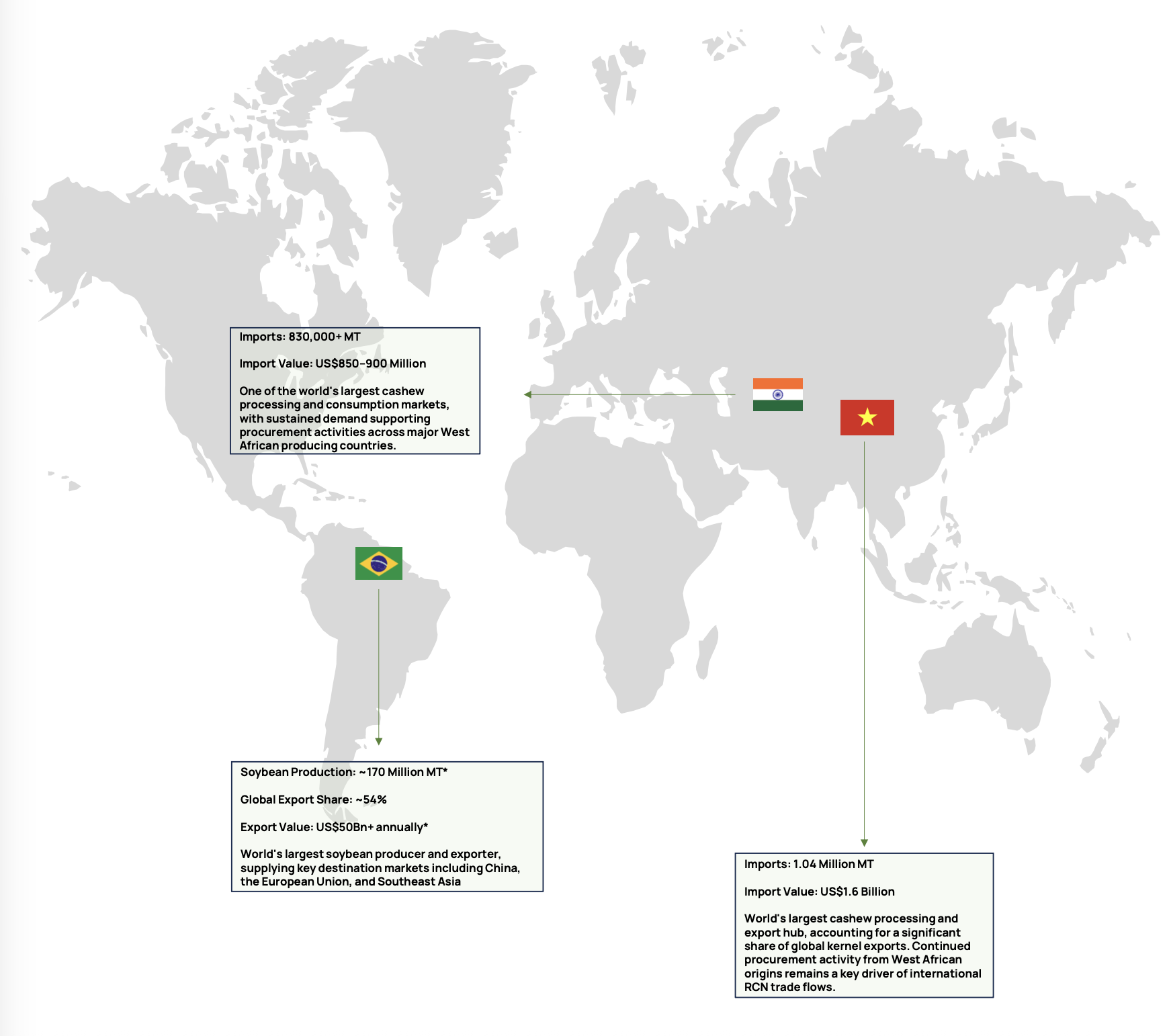
This week crystallized a market defined by two opposing forces: a supply-shock-driven rally in soft commodities (led by cocoa’s +18.5% surge) and sustained bearish pressure in grains, driven by ample supply fundamentals and record projected output from the U.S. and Brazil. Soybean Production: ~170 Million MT* Global Export Share: ~54% Export Value: US$50Bn+ annually* World’s largest soybean producer and exporter, supplying key destination markets including China, the European Union, and Southeast Asia The confirmation of El Niño and early signs of a “Super El Niño” scenario (67% probability per NOAA) raises the structural risk premium across all West African- origin commodities for the remainder of 2026 Imports: 1.04 Million MT Import Value: US$1.6 Billion World’s largest cashew processing and export hub, accounting for a significant share of global kernel exports. Continued procurement activity from West African origins remains a key driver of international RCN trade flows. Against this backdrop, market participants are advised to maintain active coverage in cocoa and RCN, given tight supply dynamics, while approaching soybean positioning with caution, given downside momentum and record supply projections.