


Global agricultural markets closed the week amid growing evidence of improving supply conditions across several key commodity-producing regions, contributing to a moderation in the supply-driven concerns that have dominated market sentiment over recent quarters. Favorable weather patterns, stronger crop development, and rising inventory levels collectively exerted downward pressure on portions of the agricultural complex, although climate-related risks and evolving trade dynamics continued to prevent a broader market re-rating.
A notable theme throughout the week was the increasing divergence between short-term supply fundamentals and longer-term production risks. Across major crop-producing regions, improved weather conditions supported agricultural output and reinforced expectations of stronger harvests. This development was particularly evident within the North American grain belt, where favorable growing conditions and accelerated planting activity strengthened confidence in upcoming crop prospects.
The improvement in production expectations contributed to softer sentiment across the broader oilseed market. Market participants increasingly focused on the prospect of expanding supply availability, reducing some of the scarcity concerns that had supported prices earlier in the year. Nevertheless, demand-side uncertainty remains an important consideration, particularly as global trade flows continue to be influenced by geopolitical developments, shifting procurement strategies, and evolving consumption patterns among major importing nations.
Within the soft commodities segment, market attention shifted toward inventory normalization and production recovery. Recent data indicated a continued improvement in cocoa stock levels, with inventories reaching their highest level in nearly two years. At the same time, rainfall conditions across key producing regions in West Africa supported crop development and improved expectations for the ongoing mid-crop harvest. These developments contributed to a more balanced market outlook following the extreme volatility experienced throughout much of the previous season.
Despite these improvements, market participants remained cautious regarding the medium- term outlook. The potential emergence of El Niño-related weather disruptions continues to represent a significant source of uncertainty for agricultural markets, particularly for commodities whose production remains concentrated within specific geographic regions. For cocoa, where Côte d’Ivoire and Ghana account for a substantial proportion of global output, weather-related disruptions remain capable of materially altering global supply expectations within a relatively short period.
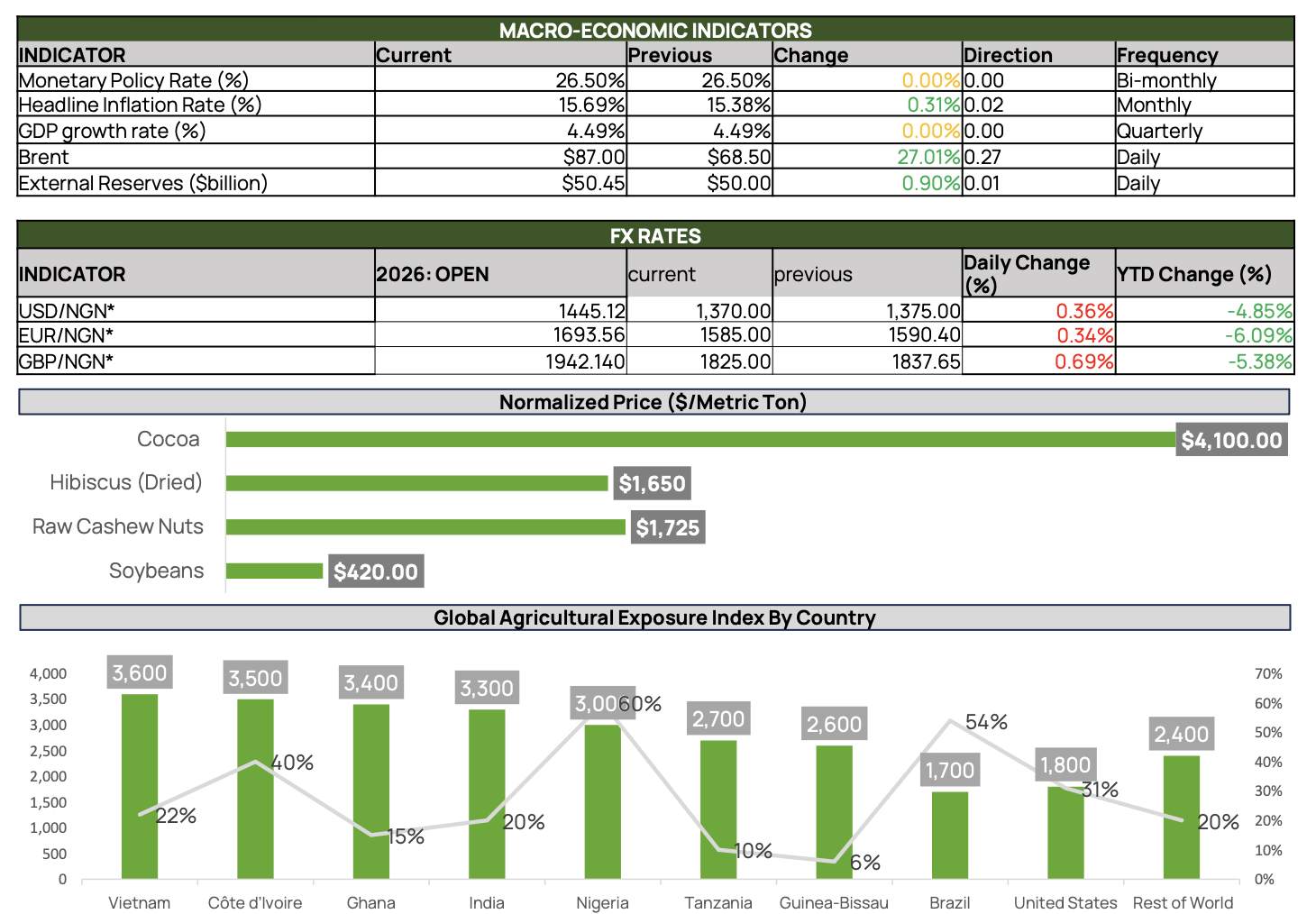
The Global Agricultural Exposure Index compares countries based on their position in the global agricultural value chain using a value-weighted USD/MT proxy rather than production volume.
It highlights a structural divide between high-value, supply-concentrated economies in West Africa, bulk commodity exporters like Brazil, and the United
States, and processing hubs such as Vietnam and India.
West Africa’s higher exposure reflects dependence on cocoa and cashew, while the Americas are driven by scale in soybean exports.
Overall, the index shows that production, processing, and value capture are geographically separated, amplifying the impact of localized supply shocks on global trade.
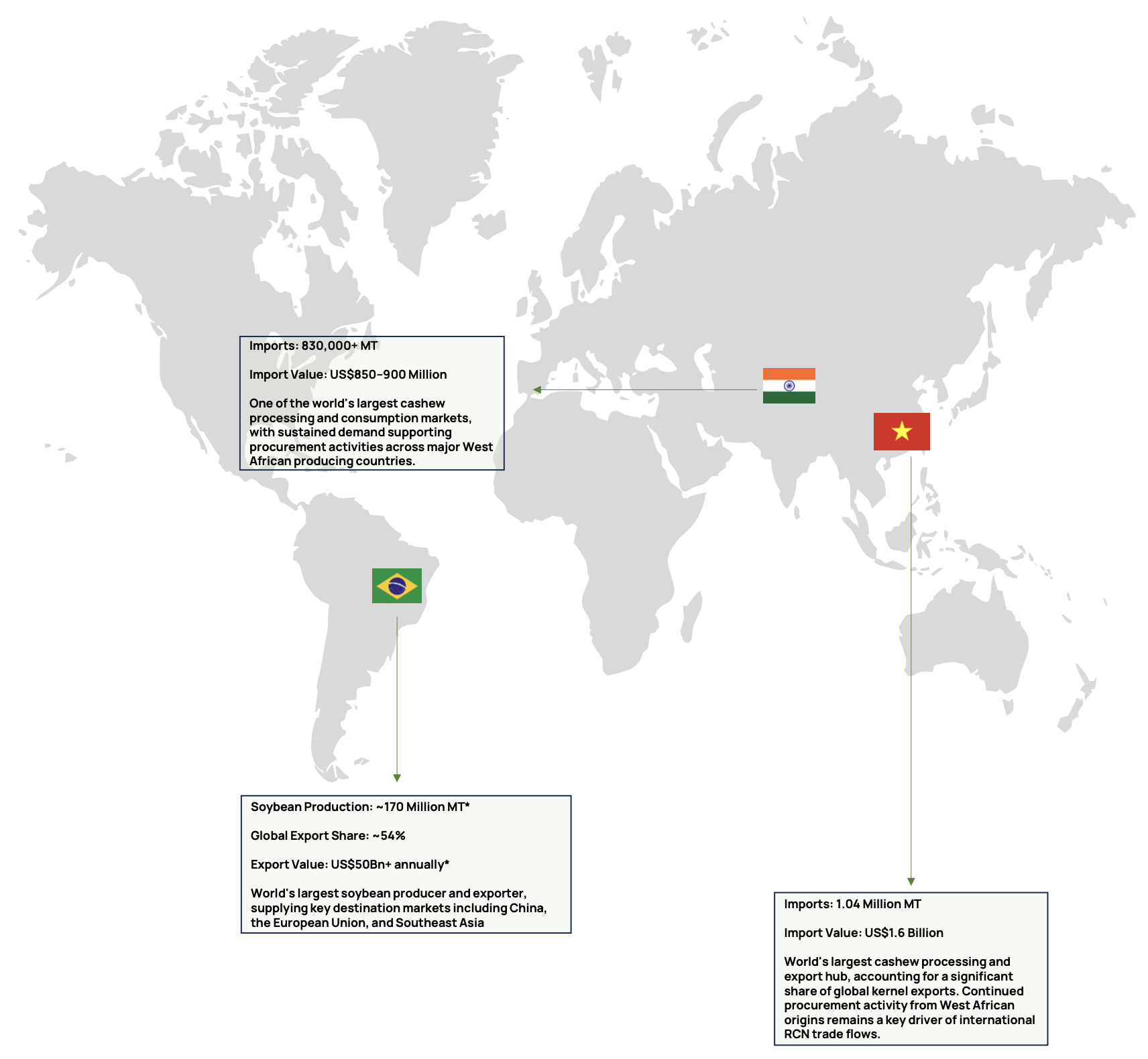
The Raw Cashew Nuts market is currently stable compared to the previous week. As the West African marketing season enters its final phase, remaining stocks are suffering from declining quality. New export contracts for July shipments are very scarce, and buyers are pricing them lower to account for low outturn (KOR) commitments.
Ivory Coast – Facing a difficult end to the season, with residual stocks struggling to find buyers as local processors and foreign buyers withdraw. Frequent stormy rains are causing severe nut quality deterioration.
Togo – Commercial activity is limited as the season draws to a close with a sharp reduction in available stocks. The persistent downward trend continues due to cautious demand and export constraints.
Market participants are actively trying to liquidate remaining stocks to avoid rain damage. The market is stabilizing and firming, indicating that prices are approaching a structural floor with limited room for further downward adjustments. While nearby spot activity remains soft, underlying market engagement is reviving, driven by forward inquiries. Shippers are showing strong resistance to lower bids as production, fuel, and raw material costs remain highly elevated. Most shippers have already secured sufficient volumes for June and July, shifting current market offers primarily toward mid to late July and August positions, where buying interest is gradually gathering pace.
US demand displays mixed signals; buying has slowed down recently following an active period in March and April. However, buyers remain engaged, specifically targeting broken grades to cover their current processing needs. While in Europe, buyers are progressively covering their Q3 positions ahead of the year-end peak season.
China’s demand remains highly vibrant, with China leading kernel imports from Vietnam this year, ahead of the US. Buyers are aggressively covering ahead of the upcoming Mid-Autumn Festival, targeting premium large sizes and driving solid upward price momentum. The Middle Eastern market is steadily bouncing back, with buyers now covering shipments for Q3. Despite the ongoing US-Iran conflict and the closure of the Strait of Hormuz, shipments to the UAE and Saudi Arabia continue to flow through Omani and Red Sea ports, actively supporting the market.